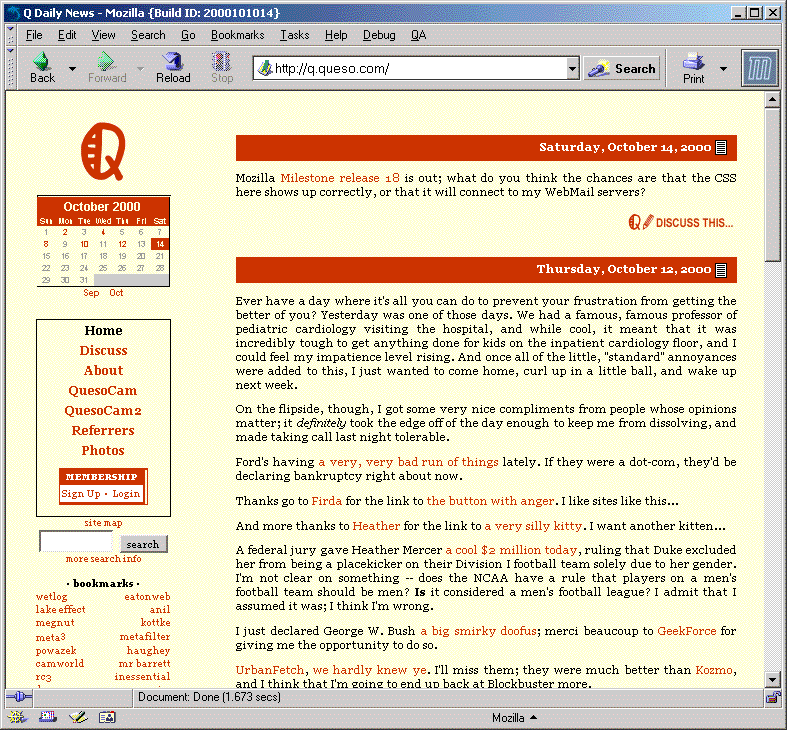
If you’re one of the people who reads this site in an honest-to-goodness web browser window (rather than a syndication aggregator), then you’ve probably noticed that I went and redesigned things around here. The last time I went and did that was in February of 2002, so that would explain why I’ve been feeling that my layout was a bit stale. Welcome to the 2006 version of Q Daily News… and keep your eyes peeled around mid-2010 for the next iteration!

A few notes on the design:

  • Given that the title and navigation never felt intuitive to me over in a bar along the right, I moved it all up to the top. Not really rocket science, but it certainly went a long way towards making the site feel right to me.
  • Over the past year or two, I’ve been trying to use categories when I write posts, if only to help gather similar subjects together on category pages. Of course, I never exposed any of this to viewing through the site (for reasons having more to do with laziness than difficulty), so I fixed that wrong. Likewise, I decided to make entry titles a little more prominent; they used to be visible only on each post’s individual archive page, but now they’re above each entry on the main page and on the monthly and category archive pages.
  • Over the past few years, I’ve been squirreling content away in various publicly-accessible web services (like the photo archive Flickr, and the bookmark storage site del.icio.us), something that always made me feel like I was competing with my own weblog. Rather than stop using the web services, it made more sense to me to bring that content back to QDN… so now you’ll see a few content areas in the righthand sidebar that weren’t there before, including the last three pictures I’ve uploaded to Flick, and the last five bookmarks I’ve posted to del.icio.us.
  • What you’ll see is now missing from the sidebar is a list of links (a blogroll, as it were); I found that my old link list rapidly got crusty as people shuttered their sites, moved URLs, or generally fell off the web. I’m tinkering with a few ideas about how to add it back and make it more current, so we’ll see what comes of that.
  • I used Tim Appnel’s mt-archive-dateheader plugin and a bit of PHP reprocessing to revamp the archive page. The long, thin list of links to month-by-month archives was always just on the barely-tolerable side of acceptable to me; at least displaying them within year blocks seems a bit more logical.
  • I was within micrometers of doing away with all TrackBack functionality (given that my last valid TrackBack was sent back in September), but I decided that the spam-filtering code in Movable Type 3.2 makes TrackBacks low-cost enough to keep around for a little while longer. I did tinker around with how they’re gathered and displayed on entry pages, though, which will make it easier to just abandon all TrackBack functionality if that’s what I ultimately decide.
rach and syd

Hi Rachie! (In the picture to the right, that’s Rach, with her daughter Syd.)

So, here’s a funny little story. My little sister Rachel came to town last night, not to visit Shannon and me (completely understandable, since we spent all of the past two weekends with her!), but rather to see one of her best friend’s new baby. Apparently, she randomly ran into one of my oldest friends — the one who passed my apartment onto me here in Brookline — in the Prudential Mall today, and while they were chatting, he made an offhand reference to Q Daily News. And therein lies the bit of hilarity… because before that mention, the only people in my immediate family who knew about this site were my brother and his wife. So of course, that conversation led Rachel to Google and then to here — and then to a phone call from my brother telling me that I’d been outed. And as it so happens, my entire family not only lives in NYC but was hanging out in Rachel’s apartment when she got back to the city this evening, so they’re all in on the gig. Which means that my earlier greetings need to be expanded: hi everybody!

(In all honesty, there’s no huge reason for the secrecy. When I started things here back in 1999, I’m not even sure that most of my family regularly checked their email, but I was more sure that they’d think a weblog was a bit weird. As time went on, it became a little bit of a challenge to see when they’d all find the site; my brother came knocking back in 2001, and I’ve always had a suspicion that my Google-loving parents have known for a little while. But now it’s all out in the open!)

Thanks, Steve; as predicted, my copyright notice (at the bottom of the right-hand content bar) was yet another that was rooted in 2004. All fixed!

I’m not a National Geographic subscriber, which means that I’m going to have to swing by the library over the next week or two — the feature article on creation vs. evolution this month looks like it’ll be a great read. (Of course, I can’t deny the added appeal in the issue’s cover text asking “Was Darwin wrong?”, and the pullquote on the first-page of the feature answering “NO. The evidence for evolution is overwhelming.”)

I’m not sure why I’m so intrigued by Google’s acquisition of satellite image provider Keyhole, but I am. Perhaps it’s because it’s one more sign that Google generally operates at the very edge of the search space, looking for ways to push those edges outward; perhaps it’s because it’s another huge data set that I’m sure hasn’t been sufficiently examined. Or perhaps it’s for one of the dozens of other reasons related to information mining, the places where wildly dissimilar data sets meet, and all the cool tools that Google’s made to date. In any event, I’m anxious to see what comes of it.

My hospital distributed PocketPCs to a group of clinicians a little bit ago, me included, and I’ve spent the past week playing around with the new toy. The platform that was standardized on is the HP iPaq hx4700, in a large part because of its built-in WiFi, and that means that in most places in the hospital, I’m able to get online. Of course, because I’m such a geek, that means that any time I get bored I find myself surfing the web. I usually end up crawling around the various sites that specialize in PocketPC-related topics, and one thing that I’ve been pretty amazed by is how many of those sites don’t do jack shit to make their pages display well on the platform. In fact, most of them don’t serve anything different to PocketPC browsers, meaning that I usually spend about a half a minute trying to find the place on the page that has content, another minute or so figuring out where the navigation elements are, and then about a microsecond giving up and hitting the back button. It’s am interesting case study in not knowing your audience, and as a result, providing a substandard experience.

After being deluged this morning with news about the changes coming Thursday to U.S. check cashing laws, I did a little bit of surfing around to see what I should know. Pretty much every single resource I found said that the most important thing that consumers should understand about the changes is that you should assume that the physical, actual check that you write completely ceases to exist at the moment that it is cashed. (This is because banks will now scan checks at the point of deposit, and then process them entirely from the information in the scan.) And this means that if a bank makes a mistake processing a check — say, they cash a $100 check for $1,000 instead — it will be somewhat harder for the person who wrote the check to prove that an error occurred. The new law anticipated this, and has a remedy: substitute checks. These are images of your checks which adhere to specific standards, and carry the same legal weight as the original check; the kicker is that many of those little images of your checks that you get with your statements don’t meet the standards of substitute checks, so you need to make sure that you specifically request “substitute checks” from your bank.

This is all confusing enough that, not surprisingly, I called my bank tonight to ask that all my statements contain the substitute checks and the representative had no clue what I was talking about. She put me on hold for about five minutes, and then came back to tell me that her supervisor said all accounts will have them on the statements, but I was less than reassured. I’ll make a mental note to call back in a few days, and see if the relevant information has filtered down.

Two long pieces that are worth the time it’ll take you to read: Tim Golden’s New York Times article, “After Terror, a Secret Rewriting of Military Law”, and Malcolm Gladwell’s New Yorker article, “High Prices”. The former is an in-depth look at how, in the post-9/11 environment, the Bush Administration went about the secretive process of rewriting a slew of laws and rules to allow the unfettered detainment and civil abuse of anyone that it decided was a terrorist, and is one of the few written pieces that has made me understand just how unimportant civil rights have become under our current President’s leadership. The latter is a well-researched, impeccably-detailed trip through the problems that surround drug prices, pharmaceutical research, and physician behavior in this country; it’s really the piece that I wish I could have written nearly two years ago.

Interesting — it appears that eBay filters the email addresses that people use in their registrations, and somehow decides which it will allow and which it won’t.

For the past three or four weeks, I’ve been dutifully going through all my website registrations and changing the email addresses associated with them to new ones, all at the domain MASSHOLE.US (which I registered a few months ago). I generally haven’t had a problem; sites from Amazon to TypePad have accepted the new email addresses without issue, and the wholesale change has let me make a few changes to my email system that has decreased the amount of spam in my inbox. But eBay has not been as accepting; each time, I get an email to the old inbox saying that I submitted a change request and telling me to expect an email in the inbox of the new address which contains a confirmation code, but I never ever receive that promised confirmation email.

The first two times I tried the change, I figured that their system was just temporarily broken, and that I would be able to try again at some later time without problem. When it didn’t work a third time, I contacted their customer service via email (using the support pages that they provide), but a week later had not received any reply whatsoever. I then tried to make the email address change a fourth time, failed to get the promised confirmation email, and tried contacting their customer service again, but similarly never got a reply. That kind of rookie behavior pissed me off a bit, but I assumed that I’d eventually get some kind of response. Alas, tonight made two weeks of complete eBay silence.

On a lark, I just decideded to try to change my email address to one on my normal domain, QUESO.COM — and lo and behold, the confirmation email arrived instantly! I then tried again to use the MASSHOLE.US address, and still haven’t received any confirmation email. I can only assume that the difference in the two behaviors is rooted in the fact that MASSHOLE.US contains an objectionable word… but the fact that their system fails silently in its rejection, leaving me completely in the dark as to whether this is actually the case, is unbelievably frustrating. Of course, in the end, I don’t know which is worse: the way that the system is set up, or the nonexistent customer service that exists to support that system.

Shannon and I watched Nine Innings from Ground Zero today, and liked it a lot. Granted, it helps that we’re Yankees fans — the documentary uses the resurgence of the Yankees during the 2001 Playoffs as the centerpiece of the story, so it’s obvious how it would appeal to the fans in us. But it’s also a nice look at how the Yankees and Mets played a role in New York City’s healing, and easily brought tears to our eyes about a dozen times. If you get HBO, it’s probably worth a view.

Jesus, our election system is so damn broken. So let me get this straight — Republicans are allowed to pass an amendment banning the use of federal funds to pay independent United Nations elections monitors, and then use $360,000 of political money to pay partisans who are supposed to make sure that everything is up to snuff? Can there be any less of a doubt why there was a loud call for international monitoring this year?

As Rafe finds himself wondering what motivates people to consider reelecting President Bush, he should meander over to the website of the Lone Star Iconoclast (the Crawford, TX hometown paper) and read some of the letters to the editor that were received after the paper’s endorsement of John Kerry. Some choice clips (all spelling and grammar courtesy of the original authors):

It sounds like you’ve gotten on the “Flip/Flop” bandwagon and I sincerely hope that ALL Texans will ban your newspaper. Anyone that would speak of a sitting President of the United States as you have and all the rest of the liberal press have should be banned.

If Kerry wins, it will because the American public has been inadequately informed. In the Bible it is recorded that in Hosea’s time, the “people are destroyed for lack of knowledge”. (Hosea 4:6) It is no different today. The Bible also says, “A double minded man is unstable in all his ways.” (James 1:8) Ignorance destroying a people is not brain science. As far as Kerry being “unstable”, that can be explained in secular terms such as schizophrenic or pathological liar.

Your options listed in your iconoclast article regarding President Bush are nothing more than fabricated lies that are extremer left-winged liberal hatred.

You should be ashamed of what you printed about President Bush. I for one, hope you fold for this stupid article. You really gave Kerry a lot of fodder for his smear campaign. You must be a room mate of Bill Burket at the local insane asylum. My God people, this is your President, your neighbor. Are you trying to have your 15 minutes of fame at President Bush’s expense?

I wish I lived in your city so I could cancel my subscription and boycott anyone who advertised in your paper. To be this stupid You deserve your candidate Kerry.

Your reporting is biased and childish and you rant and rave like a renegade who can’t quite find the cause that he is seeking, so you make things up as you go. I will be glad when one day soon, I try to pull up this website and I find that you are no longer in business. I must ask. Are you redneck or stupid, or both? I have to guess that you must be both, because either one alone would not be quite enough to pull off a moronic blunder such as you have. As many, many thousands of others, I am thoroughly disgusted and appalled. Proud to be a supporter of the greatest president this country has ever seen, George W. Bush.

And, my personal favorite:

You have just made fools of yourselves. With the moron you put on msnbc.. Notice the old barn in the back ground. You could probably get a better spokes person there! Lets see how far your ratings go down. Your gonna indorse a candidate that waived a vietnamiese flag in public and went against his own fellow servicemen, and can’t tell the same story twice the same way. You have just lost major credability,, Not just state wide but nation wide.. I would be looking for a good bankruptcy lawyer.. Your gonna need it! You need to change your web site for home of George Bush to traitor of George Bush! Mr. Smith go fit yourself for a turbin, because if your candidate wins we will all have to wear one and learn arabic..

It’s not hard to see where at least these people are coming from…

Well, wasn’t that game seven less than fun. I’m happy for the Sox that they’re in the World Series (and finally have the chance to avenge the infamous E3 in 1986!), but it pains me that they went through the Yanks — outright embarrassing them with a first-time-ever four straight postseason wins — to get there.

Good luck, Red Sox!

Yep, I want the Yankees to win; yep, I’ve been crushed by the last three nights of my beloved Yankees forgetting that they have, you know, bats in their hands that are capable of, whaddyacallit, hitting the baseball. More than anything, though, I’m excited that, after the game tonight, this series will come to an end. Three straight nights of white knuckles and minimal sleep, and I’m pretty much toasted. You’d think that being on what felt like permanent call to the hospital last year would have prepared me for this paltry few-day stretch of baseball, but somehow, it didn’t.

Oh, and I couldn’t agree more — mama mia, did the fans at last night’s game reflect poorly on the Yanks. I’d hope that some time was spent by stadium officials today looking at video footage, and that there will be a few people turned away at the gates tonight…

In the past five weeks, my email scanning log shows the following statistics:

  • Total incoming emails: 40,128;
  • Number of those emails which were not spam: 1,386 (3.4%);
  • Number of those emails which were spam: 38,742 (96.6%).

In addition, about 100 emails have slipped through the cracks in that time period (they weren’t caught by SpamAssassin for whatever reason), which means that that percentage increases to 96.8%. I’m in the middle of modifying things with my mail system that should decrease that number massively; right now, for a variety of reasons, I receive email sent to any address at queso.com, and that’s the main reason why I get so much spam. I’m fixing all those reasons, though, so I expect to see a bigtime reduction in the next few weeks.

For those of you who are also watching the ALCS matchup between the Yankees and Red Sox: the infield fly rule. Who knew you could learn something new during about the rules of baseball during a playoff series?

I’m rarely one to hawk affiliate deals, but I got an email from Dell tonight that has a few offers in it I’d imagine might be exactly what some people are looking for. Here they are, for those who’re interested:

  • Take 30% off of any Inspiron laptop priced at $1,299 and above; enter coupon code “NKDP1HNP271J00” at checkout.
  • Get a 2.8 GHz Pentium 4 system with 512 Mb memory, double-bay CD drives, and a 15” flat panel display for $499; click on this link or put in eValue code “1-D24BSDU”. And then, use coupon code “FMRRQRTFFK2LV0” at checkout to get an additional $70 off!

Both of these offers end on 10/18 at 5:59 Central time.

In an effort to stem the flow of spam to the addresses I use for domain name registration, I decided today to set up a new mail account for all my registrations, use sendmail’s plussed users feature (also here) to be able to give each registrar a different email address, and then put a set of tweaked spam filters on that account. I started going through all the registrars I’ve used, and successfully changed my email address with four of them. When I got to GoDaddy, though, the interface would not accept the new email address, and after talking to them on the phone, it turns out that their system does not accept plus signs in addresses. The technical rep didn’t know why this restriction exists, and his supervisor said that there’s no changing it.

It’s an odd decision on their part, given that the plus sign totally valid according to the RFC which governs such things; it’s as if they also decided that their system wouldn’t accept registrations for domain names with the letter “z” in them. And given that sendmail is the most used mail transport agent in the world, it’s hard to see why GoDaddy would enforce a restriction that actually has a specific function in the application, but whatever. All in all, it’s funny for a company which exists to support the internet standard of DNS to be so clueless when it comes to another internet standard, email.

I had an odd Linux crash this morning that I just don’t understand. I got a call from Shannon saying that the webserver wasn’t responding; I tried to ping it, and it didn’t respond. In fact, no services (web, mail, FTP, ssh) were responding, so I walked over to the machine, and while it was running (I could hear the fan spinning, and the lights on the front were lit), I couldn’t get anything at all on the monitor. I ended up having to hit the reset button, after which it came back up just fine.

Looking through the logs, there is truly no clue as to what happened. The main log (/var/log/messages) shows that the IMAP server processed its databases successfully, and then the next entry is from almost six hours later, when I reset the machine. Every other log — mail, cron, security, webserver — shows the same thing: entries up until around 3:02 AM, and then silence for nearly six hours, until the machine is restarted.

This machine has been running fine for a while now — I’ve had eight-month stretches without reboots — but in the past three or four weeks, I’ve started installing all the services that will allow it to become my primary web and mail server. Maybe one of them took it down; without log information, it’s hard to know, though. I’ve started to do a dump of the memory state every five minutes or so… maybe that’ll give me some insight into what happened. Any other ideas?

ESPN’s Sports Guy, Bill Simmons, is the kind of funny that leaves me laughing hysterically, in tears, gasping for breath.

A few notes on some things that have crossed my screen in the last 24 hours:

Now, for a night of awesome competition (Yankees vs. Red Sox, Kerry vs. Bush)!

This and this make me want to vomit. I’m happy to see that both stories were broken by local news affiliates; I’m also happy to see that, in both cases, the whistleblower was able to bring shreds of the torn-up forms to the relevant elections supervisors who confirmed that the voters had never been added to the rolls. (Of course, thanks go out to Josh Marshall, both for these links and for the great work he’s doing ferreting out stories like this.)

Little bit of a power outage this morning here at Chez Queso, meaning that this site and a few others were silenced for a bit. We seem to be back now; hopefully, the lifegiving juice will continue to flow!

Since I’m completely incapable of watching Presidential debates on television (and hell, there’s a baseball game on!), I’m instead enjoying the hell out of Paul Begala’s live debate weblog over at CNN. So far, my favorite:

Bush just said: “I hear there’s rumors on the Internets.” Is there some secret second Internet I don’t know about? Perhaps that’s where Bush gets the information that tells him things are so peachy in Iraq and the economy’s strong. He’s living in his own Private Idaho, apparently reading things on his own private Internet.

In the wedding planning process, it’s right about now that you realize that if just one more facility uses the phrase “Where dreams come true!”, you’re going to throw up. Let’s get this straight, people: the only way a location will make any engaged couple’s dreams come true is if it’s free, beautiful, comes with all the alcohol people can drink, has no limits on catering, music, or hours, and has a 42” plasma screen television and DVD player to keep the kiddos occupied while their moms and dads celebrate.

I’m finishing off a project I’ve been working on for my old hospital, and find myself evaluating rich HTML text editors — those little dealieboppers that let someone enter text into a web page and make it bold, underlined, in list format, whatever. (Given my druthers, I wouldn’t integrate one into the project since I’m much more comfortable coding text formatting by hand, but the intended users of the app want and need to be able to use the button-based editing interface.) I’ve come across a few, and am interested in any opinions people have as to benefits or drawbacks of any one of them (or any others that they might have seen while meandering the web).

The few that I’ve played with, either by downloading and installing or using an online demo, are: Kevin Roth’s Cross-Browser Rich Text Editor, Editlet, pinEdit, TwistText Rich Text Editor, and Elktron’s eWebEditPro. Out of those five, the first is the clear victor — it’s free, works in most browsers (not Safari, oddly), has no license that limits use, puts out decent code, and is easy to integrate into a project. The rest of them either cost a bundle, try to do way too much, or don’t work in some of the large-share browsers, making it hard to see how they would actually add to the application.

Opinions?

God, that Yankees game was a nailbiter. What poetic justice that the Twins were robbed of an assured run by a ground-rule double in the 8th… and then the Yankees were equally robbed by a ground-rule double in the bottom of the 11th. There’s nothing to bitch about, just solid baseball and a squeaker of a finish!

And now that I’m done with my Thunderbird playtime, I think I’ll take a week or two to kick the tires of three new (or new to me, at least!) apps that I hope will find a place in my programming setup: Smultron, TextMate, and VoodooPad Lite. The first two are geared to be hardcore text editors for programmers — syntax coloring, code libraries, and the like — and the third is more of a notepad to help keep track of all the information that doesn’t make it into the code. They all look cool, so I think it’ll be fun to see what they can do!

I’ve been playing with Thunderbird on my Powerbook for about two weeks now, and I have to say I’m generally underwhelmed. My biggest issues:

  1. Frequently, Thunderbird manages to show me a message in the mailbox list, but not let me actually see the message. For example, I currently have twelve messages in one of my folders, and while I can see the list entry for all of them, when I click on a specific one of them, the preview window is empty (well, save for the header information from the message that I was reading prior to clicking on it). Likewise, double-clicking that entry brings up a blank message window, and going to View/Message Source brings up a blank window, as well. And there’s nothing I can do about this — there’s no command to refresh the mailbox. Annoyingly, when it’s a message I really care about reading, I actually have to delete and recreate my entire mail account, then re-enter all the settings, and finally open the folder and read it. That all seems a bit much.
  2. There seem to be major problems with offline mode. I have a filter on my mail server that puts all my mailing lists into a specific folder, so that they stay out of my face when I’m busy but are easily perused when I get a few free minutes. Since those free minutes tend to pop up when I’m disconnected from a network, I have Thunderbird set up to download all the messages in the lists folder when I tell it to go offline. Alas, it seems that the program randomly chooses which messages to download, and as a result, I’m frequently left with half of them being unavailable, and no network connection to remedy the situation.
  3. If you add the previous and next buttons to the toolbar, they use the behavior that views the previous and next unread message, to much annoyance. This means that, instead of sending me to the next message in my inbox, Thunderbird frequently sends me to some message that was filed in one of my 150+ mail folders. The Go menu has entries for both options — read the next/previous unread message, and read the next/previous message of any type — so I know that Thunderbird knows how to behave correctly; the binding of the unread-specific functions to the buttons doesn’t make a lot of sense.

That’s what I have so far… I’m sure that Thunderbird will mature a lot in the move from 0.8 to 1.0, but until it does, it’s not the mail client for me.

si dailies, atlanta 1996

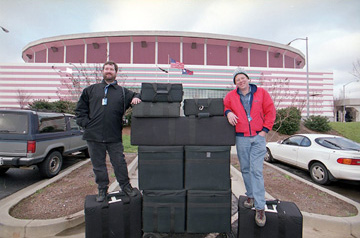
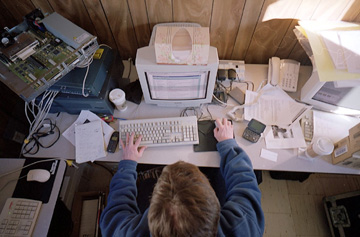
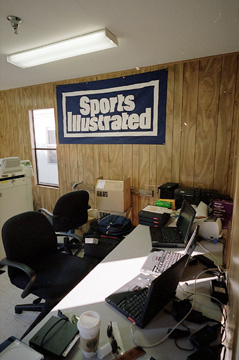
It makes me happy to have finally gotten off my ass, found good mylar sleeves, and packaged up all my copies of Sports Illustrated’s daily 1996 Olympic magazine. I ended up having two complete sets, and as many as seven or eight of some issues; now, they’ll all go into storage to give to my kids some day. (And, of course, there’s that magazine issue in the lower right hand corner, which makes me very happy to own!)

I’m not quite sure how I missed Typographica’s thread from November on the best font for programming, but I did. There are a slew of great suggestions in there, including Mark Simonson’s Anonymous, Bitstream’s Vera Sans Mono (screenshot here), and Lucas de Groot’s TheSansMono. I’m always looking for something that’d be easier on the eyes… time to play a bit!

I just realized that I forgot to post the requisite how-long-did-it-finally-last update for my iPod. So, the answer is 7 hours and 50 minutes. I still don’t understand, but have decided to just go with the flow. I’ll hang onto the replacement battery, but not install it until this battery tanks again. (By my estimate, that should be between a few days and a few weeks from now!)

SpamAssassin 3.0 is out! Notable in this release is the inclusion of a check against the Spam URI realtime blocklists (a huge help in the fight against spam), use of Sender Policy Framework tests (a huge help in the fight against fraudulent return address information), better integration with databases for storage of preferences and filter information, and a move into the Apache Software Foundation. If you run a mail server, you’d be doing yourself and your users a favor by hopping over and grabbing it.

And now, for an update to last night’s iPod story:

After 2 hours, and a battery indicator that flickered between two and three bars of remaining life, I decided to plug the damn thing into the charger and go to sleep. This morning, at 8:57 AM, I unplugged it, hit play, threw it into my backpack, and came into work. Right now, it’s four hours and 13 minutes later, it’s still playing, and the battery indicator is still showing four bars of power left. And I’m truly, completely baffled.

Remember — the only thing I’ve done is taken the back off of the iPod! Is it possible that the battery life can somehow be affected by whether or not the back is attached? I don’t see anywhere obvious that the battery could be shorting against the aluminum; what else could I be missing?

This is just freakish, and as sure as I am that I can’t explain what’s happened to the battery, I’m equally sure that the moment I decide that maybe I don’t need the new one and send it back, the seven-minute lifespan will return.

I don’t understand my iPod.

I have a first-generation, 10 gigabyte iPod, and over the past year, the battery life has been getting worse and worse. I decided to pretty much give up on it as a portable device about two months ago, when I disconnected it from the charger (into which it had been plugged for the prior 10 hours), started walking to work, and seven minutes later, it died with a low-battery warning. At that point, Shannon and I bought a cigarette-lighter power cord for it and relegated the device to a road-trip role in our lives.

Earlier this week, I happened upon a posting about an affordable extended-life replacement for the battery (I’d love to give the author credit by name, but he or she doesn’t really make a name accessible anywhere obvious!), and after a little hemming and hawing, I decided to give it a shot. I placed the order yesterday.

Given that, of course today was the day that Anil decided to email me a link claiming that all you need to do is open the iPod up, disconnect the battery, and reconnect it, and like magic, the battery’s long life would be restored. I cursed a bit, knowing that my replacement is about 10 hours away from delivery to my doorstep, but tonight I decided that it couldn’t hurt to give the unplug/replug method a try. I opened the little guy up (not as easy as I’d thought it would be!), but then realized that I hadn’t turned the iPod on to see what the current battery state was. I’m a scientist, after all; what kind of scientist would I be without data from both before and after the battery disconnection? So I powered the iPod up.

And therein lies the second surprise of the day. It’s now been almost three weeks since we’ve used the iPod — that was our last roadtrip — and since then, the device has been sitting in a drawer. Under normal circumstances, that would mean I could expect about three or four minutes before power-off… but of course, today doesn’t seem to be normal. It’s now been 75 minutes since I hit play, and the battery indicator shows three bars remaining.
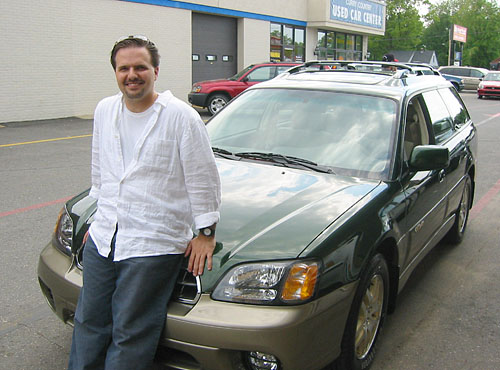
No, really — I don’t understand.

I see that now, our country has upped the ante, moving from shitting on people’s basic rights to trying to prevent the Supreme Court from defending people’s basic rights. Americans can complain all they want about the downward trajectory this place is on, but when push comes to shove, all these policymakers were either elected by us or appointed (and approved) by the people we elected. And if we continue to elect and approve asshats who’d rather pillage the Constitution than read it — or worse, not vote, and let others choose our fate for us — then we’re to blame.

Wow, jetlag sucks. My brain thinks it’s 4:30 AM right now, and my coordination seems to be following suit.

From San Fran, a few skyline images from the Maritime National Park:

san fran skyline
skyline across the bay from san fran

Shannon and I escaped to San Francisco for the next few days; we had an eventless flight out here (thank God for inexpensive, direct mid-week flights from Boston to San Fran, curse God for out-of-control kids and their “I want my kids to think I’m cool, so I’m not going to discipline them” parents sitting near us on said flight), and collapsed in a heap last night when we realized that, in our brains, it was actually past 3AM.

Today, Fisherman’s Wharf, the Golden Gate, and whatever else we can find to enjoy this beautiful weather! And with the clouds and rain that’s in the forecast for Boston, it looks like we hopped over to the Left Coast just in time…

It seems that, with today’s appearance of Mozilla Firefox Preview Release 1, we have the first general-availability build of Firefox that integrates the fix for the annoying-as-hell cookie problem. (For those who don’t remember, or are too busy to click through that link, the problem is that most Mozilla browsers limit you to a certain number of cookies before they start deleting them, meaning that you end up having to log back into your bank sites, news sites, and whatnot on a seemingly-random basis.)

There’s an important note about that fix, though: without doing a few manual config changes, you’ll only see a marginal improvement. The old Mozilla way of doing cookies was that you were limited to a total of 300, and this fix increases that number to 1000, a number that should get you a few more days’ worth of browsing before your website logins start expiring. That being said, the official specification states that “cookie support should have no fixed limits,” and that browsers “should strive to store as many frequently-used cookies as possible.” A way to approximate that behavior would be to increase the maximum number of cookies to the highest the pref allows (network.cookie.maxNumber, 65535); this should change the behavior back to that which you’d expect from cookies. (If you don’t know how to increase it, take a look at the MozillaZine guide to the about:config window.) I’m not sure how Firefox will handle the increased number, stability-wise — for all I know, the limit was there because the cookie-handling code isn’t comfortable dealing with more than a thousand — but I can tell you that not having to dig my wallet out to find my bank card number every week will make me a lot less annoyed.

Looking at my last three posts — damn, am I a geek. I need to get out more… :)

This morning, I awoke to an email from El Oso telling me that the link to my archive list was broken; sure enough, it was, and that was totally confusing to me, seeing as I had made no recent changes to the structure of my site. It bugged me the whole way to work, and despite being in clinic all day, between patients I kept sneaking a peek at the relevant bits of code to see if I could figure out the problem. I wasn’t able to find anything overwhelmingly wrong, though, other than the fact that the the archive index page was just plain horked.

After clinic, I dug in a bit deeper, and finally found a post over at WebmasterWorld that seemed to describe the problem I was seeing — and happily, it made it seem like the problem was a bug in Apache (and specifically, the version of Apache to which I upgraded two weeks ago), rather than some dumbassed configuration error on my part. I came home and put together a test case that reproduced the behavior I was seeing, and then submitted it to the maintainers of Apache as a bug. We’ll see what comes of it; in the mean time, I threw together a workaround so that my archives can shine once again!

(And of course, if there are any Apache wizards reading this, feel free to take a look at the test case and point out where my understanding of mod_rewrite and mod_dir completely sucks; while I feel that there’s likely to be a bug here, I also recognize that there’s just as likely to be an idiot with a poor understanding of Apache on this side of the keyboard.)

In doing some email maintenance today, I noticed that American Airlines didn’t have my current address information. I meandered over to their website to update it, and after submitting my changes, I got an error saying that they were unable to validate my apartment number. I tried everything I could to get it to accept my full address, but alas, the only success I found was when I submitted my address without an apartment number. At that point, I noticed that despite me entering a 5-digit ZIP code, the confirmation page contained a ZIP+4. That means that they do some sort of back-end processing of the address to generate the nine-digit ZIP code; from the error I got with the inclusion of an apartment number, I assume that the back-end also includes some sort of verification that my address actually exists in a big property database, and that that database doesn’t recognize the fact that my building is divided into apartments. As a result of that deficiency, their database contains an incomplete address for me, which benefits nobody at all. This all highlights the fact that, if you’re designing a web-based application and testing the data that people enter, you need to make sure that that test achieves its goal of providing better data without also setting up situations wherein the data becomes worse. That means one of two things: either your test needs to be 100% reliable, or you need to provide a method for people to clarify their entry when the test fails. And since the first option is nearly impossible to achieve, you’ll find that the second option is way more important.

It makes me sad when ostensibly tech-savvy writers completely miss the point of a technology they’re covering.

MX Logic, a company that provides both products and services touted to increase email protection and security, released a report this week that says that email spammers are now using the Sender Policy Framework in an effort to “dodge both legal and industry-backed efforts to curb spam.” A few news outlets — Information Week, CNet News, The Inquirer — all picked up the report and ran with it, implying that the SPF standard is more or less a failure at what it was designed to achieve.

What’s the problem? It’s that SPF wasn’t designed to eliminate spam! The standard exists so that when you receive a piece of email from a certain return address, your mail program can check to see whether or not that address is a forgery or the real deal. As a result, the goal of SPF isn’t to eliminate spam, it’s to implement trust — you are better able to trust that the email you receive is from who it says it’s from. A quote from the official how-it-works page sums it up nicely:

SPF aims to prevent spammers from ruining other people’s reputations. If they want to send spam, they should at least do it under their own name. And as a user, SPF can help you sort the good from the bad. Reject mail that fails an SPF check. Use it to help your spam filters make a decision. Have confidence that mail that SAYS it’s coming from your bank, your credit card company, or the government really is!

As for that latter bit — helping filters make decisions about the likelihood of an email being spam — the key is in the implementation. And while I can’t speak about all spam filters, I can say that the filter I use, SpamAssassin, does the right thing. If an email fails the SPF test (indicating a forgery of the return address), then SpamAssassin considers it more likely to be spam. But on the other hand, if an email passes the SPF test (indicating that the return address is likely to be legitimate), SpamAssassin doesn’t add or subtract anything from the likelihood of it being spam — it’s a wash.

And now, for the important bit, and the bit being left out by the news coverage: when spammers use SPF to try to increase their legitimacy, all they do is verify that the site they’re using to send their junk is real. That means that those fighting against spam (filter authors, lawmakers, whoever) are then able to take action against that site without fear that they’re netting an innocent bystander, and that’s a good thing for everyone.

Oh, yeah, and one more thing the press neglected to mention: the report that forms the basis of the news was issued by a company which sells spam filters. The more doubt they can plant in the effectiveness of other solutions, the more business they can drum up for themselves… seems like a fine reason to shout loudly that SPF isn’t working, but also doesn’t make it any more true.

Seriously, How to Pick Up and Carry Your iMac G5 might be the dumbest technical note I’ve ever seen published by a computer manufacturer. Are they really saying that someone might be slow enough to be unable to figure out how to carry a computer, but would be quick enough to figure out how to use the Apple knowledge base to pose the question? It boggles the mind.

This morning, while perusing all the postings my aggregator gobbled up overnight, I noticed that a bunch of people posted links to VoteOrNot.com, specifically affiliate links. VoteOrNot.com appears to be a sweepstakes being run by the guys from HotOrNot.com, allowing people to register to vote in the November election and aiming to give $100,000 to one person who registers through the site. They’re also going to give $100,000 to the person who refers the eventual winner, hence the affiliate links from everyone.

I figured that it would be a no-brainer to go over and sign up; while I’m registered to vote, I’m not averse to winning money by encouraging others to do so. Then I took a look at the signup form, though, and started thinking twice about the whole deal. They ask for my email address, physical address, and phone number, and make sure to have a statement above the form saying that they only need it to contact me if I win (sounds good). But then they ask me to agree to their Terms & Conditions, which says that by registering for the site, I “may sign up to receive email from Eight Days, Inc. (Sponsor),” and that I “can remove [myself] from the email list by following onscreen instructions” (sounds a bit more suspicious). And then came the kicker: under the personal information section of the T&C, I’m referred to the Eight Days, Inc. Privacy Policy, “available at Sponsor’s web site, http://HOTorNOT.com,” but going to that site, there’s no privacy policy anywhere to be seen or found. Even a Google search turns up nothing.

And that’s the ball game; they ain’t getting my personal information. You’d figure that a site that’s trying to encourage people to get out and exercise their civic duty would exercise a bit of its own…

Update: After an email interchange with James Hong, one of the founders of HotOrNot and VoteOrNot, a privacy policy is now in place at VoteOrNot that seems strong enough to make someone feel comfortable giving up personal info. James also let me know where to find the policy on the HotOrNot site — it’s in the tiny little scroll box on the page that lets you submit a picture for rating. Seems odd to hide it like that, but then again, it does say that they will “provide this personal information to third-party service providers who help us maintain our Service and deliver information and services to you and other users of our Service.”

giant cutter-thingy

No, really, this is the coolest machine I think I’ve ever seen. I really, really have to know what it’s used for (well, other than the obvious cutting-like things).

Update: Rafe, ever the diligent researcher, passed on this link showing that the behemoth is actually an excavator, and this Jamie Zawinski discussion thread in which someone linked to a Lego version of the thing. Awesome!

I’m in the midst of moving this site to another server; if you can see this message, you’re seeing the new site! Things should settle out in the next 24-36 hours, at which point I’ll start playing around with a bunch of the new Movable Type 3.1 stuff.

She said yes!

pretty ring on a beautiful girl

(And to preemptively answer the two questions that were the first out of everyone else’s mouths: we don’t know where, and we haven’t firmed up when. We’re just enjoying the moment for a little bit!)

Hmmm — I wonder what would happen if some random New Yorkers showed up on the grass in the backyard of 1 Sutton Place with beach chairs and books, and just soaked up the sun for an afternoon? I bet that a uniformed doorman-like functionary or two would come and try to escort them off the property, but if said group of people refused and demanded that the police come arbitrate, it seems that it’d be hard for 1 Sutton Place to make a compelling case. I’m just saying…

I promised a few people that I’d summarize my experience with DropCash, and after the (astoundingly short) 13-hour duration of my campaign, I’ve grabbed the information from PayPal and done a few calculations. Here’s my rundown.

I’ve been playing with Andre and Jason’s new bauble, DropCash, and I’ve gotta say I think it’s the bee’s knees, for a couple of reasons. First of all, it’s an awesome demonstration of how you can weave a bunch of different tools together into a seamless application — DropCash uses TypeKey for authentication and PayPal for the transactions, and hooks into both through their respective public APIs. Second, it layers an element of community atop the otherwise mundane task of requesting money, and since people generally would use services like this to ask for money from a community of their peers, I think it’s wicked cool to include community elements in the app itself. And third, DropCash itself is cleanly designed and quick to use, both of which are enviable in this era of overengineered and inscrutable web applications.

So, of course, what does a dork like me do when he starts playing with a new web application? Create a test case! I set up a campaign to raise enough money to buy a hardware firewall and VPN server for my home network; since I have a few big servers running here (including the one that hosts this very website, a moderate-volume mail server, a curriculum server for my old pediatrics residency, and the MetaFilter server), I figure that it’s a worthy goal to go for a dedicated, easy-to-use box to protect it all. And if I don’t raise enough, I can always put the money straight into the help-keep-MetaFilter-air-conditioned fund!

Lying on my bed trying to get the room to stop spinning and my stomach to stay in my lower abdomen, I came to the conclusion today that rollerblading isn’t much in the way of cardiovascular exercise.

I love the new popup killer that’s part of the Windows XP Service Pack 2 updates to Internet Explorer, but I have a question. Is there a way to tell IE that, for specific websites, you don’t want the Information Bar to appear and alert you that a popup has been blocked? For example, everyone knows that CNN went the way of the devil a long time ago, and that a popup will try to, well, pop up every single time you go to the home page. How can I tell IE to just silently block that attempt from cnn.com, but still let me know about other websites’ efforts to annoy me?

If the registration data of online news sites is really trustworthy, then I guess the Washington Post has proof that I’m, variously, a four year-old female Vice President-level attorney in the agriculture sector, a 103 year-old male hourly social worker for the packaged goods sector, and a 42 year old unemployed female energy veterinarian. Seems trustworthy to me!

While I’ve installed XP Service Pack 2 on one machine and had not one whit of a problem with it, I understand why corporations are wary of rolling it out at this point, instead opting for the (reasonable, logical) step of testing it in-house to integrate it properly and make sure that it doesn’t break any business-critical applications. Apparently, so does Microsoft — on Tuesday, the company released a set of policies and scripts which will block the download of the Service Pack, from both the Windows Update site and the automatic update process. Smart move, and shows a fine awareness of the reality of computing in a corporate environment.

If you’re hankering to understand the changes introduced by Windows XP Service Pack 2, you might want to take a look at the TechNet document dissecting the update, and also spend some time reading Tony Chor’s higher-level description. (Chor is the program manager for the Internet Explorer team, so his document is geared more towards the IE changes introduced in SP2.)

Madness is trying to debug a Windows ME laptop. Seriously, the past 24 hours of my life have been devoted to a machine that works beautifully when it’s sitting there all by its lonesome, but freezes solid when you plug a network cable into its built-in ethernet port. Luckily, the laptop’s owner is a dialup user (they still exist?!?), but it’d be nice to give the laptop back to her with everything working just ducky.

(Update: I’m giving Ask MetaFilter a whirl on this one, to see if there’s anything I haven’t thought of!)

Wow, there are so many things one could say about Bush’s denouncement of legacy consideration in the college admission process that I wouldn’t know where to begin. Would this man have achieved anything in his life if it weren’t for legacy considerations?

We’re 544th! We’re 544th! (See here for some background.)

The more I read about the Swift Boat Veterans for Truth, the more sad I become about how easy it is to manipulate facts in the minds of the American voter. Too many people actually believe what these people say, despite the incontrovertible fact that every single living boatmate of John Kerry has stood by his side and unquestionably supported his Vietnam record. Alas… I’m sure it’s more that people don’t necessarily believe them in an active sense, but rather, they passively allow the group’s message to support already-set political beliefs. It’s similar to hearing, on NPR this morning, a voter express how strongly he stood for George Bush and the Republican Party based on his belief in smaller government and less federal spending; I can’t imagine that there’s any amount of data one could feed to the guy about the reality of the Bush Administration on both counts that would cause him to change his mind. So what we’re left with is an election, for what is arguably the most politically important job on Earth, that has less to do with the actual people running against each other than it does the allegiance people feel towards the parties that support the two men. Sad.

I’m currently playing with webRemote, a little app that runs on your Mac and lets you control iTunes from any machine nearby on the network. It’s not revolutionary so much as it is incredibly useful, especially in my new office configuration.

I’m not quite sure yet what to make of this graph of Bush’s approval rating superimposed on a chart of the timing of terror alerts, but it certainly is interesting.

Seriously, this might be the week to avoid saws.

If anyone out there is thinking of trying out one of the “RAM optimizers” that are heavily advertised on a lot of the tech sites, you might want to read this excellent dissection of these scam-filled products by Mark Russinovich. Every last one of these applications can actually hurt your computer’s performance by forcing the operating system to move actively-used information from the machine’s very fast RAM to its very slow hard disk-based virtual memory file, and as a result, you take a big hit as your applications have to copy that information back into RAM once they need it again. Most importantly, the peddlers of these applications rely on people having a belief that there’s some intrinsic, universal benefit to having a huge chunk of empty RAM hanging around… but most programmers will tell you that this is an untenable generalization, especially when there are tasks that are running which could benefit from having access to that fast RAM. (For a good example, look at a memory usage map on most any Unix machine, and you’ll see that the physical memory is almost always in use to the tune of over 80%. That’s because the Unix operating system has always understood the value of using the much faster RAM as much as possible to complete tasks.) Sure, some gamers want access to every last bit of memory to run their super-complex shoot-em-ups, and maybe this is the class of user that needs these products… but you’d think that the game programmers would then just build the functionality into their games, no? Seems logical to me.

(And do you think these RAM-boosting scam artists told the folks over at Download.com that they stole their download icon?)

OK, I’m done being a total geek for now.

Over at Slate, Andy Bowers has made a great discovery: based on their weight, most SUVs are banned from a great deal of California roads. As you’d imagine, the laws that ban them aren’t enforced at all, but the logic behind them — that vehicles over 6,000 pounds cause more wear and tear on residential roads and are more dangerous to pedestrians — is solid. According to the article, law enforcement officers seem to draw a big distinction between commercial and personal vehicles, and ignore the Tahoes, Hummers, Escalades, and Land Cruisers as a result But why should people be allowed to buy these behemoths explicitly because they’re heavy enough to classify for a commercial vehicle tax writeoff, but then not have to adhere to the commercial vehicle laws in ther communities? It’s all a bit silly.

Well, it looks like I went to Nantucket a bit too early, since in as soon as a month, a startup is looking to blanket much of the island with wireless service. I love the name, too — ACKblast — which reflects the three-letter code for the Nantucket Airport.

The Apple Product Cycle. It’s funny because it’s true!

Once again, I’m certainly one of the last people to this party… but for those who straggle even further behind, you really should read Ron Reagan Jr.’s Esquire article on the Bush Presidency. Entitled “The Case Against George W. Bush,” it’s not too difficult to figure out where Ron Jr. stands on the merits of the 43rd President of the United States; the piece is very well-written, with Reagan pinning most of his arguments on a fundamental inability to trust Bush. I can only hope that the press starts to pick up on this a bit, and document much of the travesty that has been the past three years of governance in this country.

I’m unclear how I’ve been in Boston for over a year now and never been to Nantucket. Shannon and I came out here for a wedding this weekend, and between the amazing weather and the beautiful island, it’s just awesome. Sure, everything’s about 200% the cost as it would be back on the mainland, and sure, last night was foggier and muggier than your average sauna, but that’s fine when the payoff is days like today. It’s crisp and nice out, thin wisps of clouds streak the sky, I’m sitting out on the wharf watching the boats coming and going, and the breeze off the water couldn’t be more perfect. (And thanks to what may well be the slowest WiFi connection I’ve ever experienced, I’m able to catch up on all the email I ignored yesterday in my effort to get out here!)

I need to take advantage of the world outside Boston a little bit more, I think.

If you missed Barack Obama’s keynote speech last night, and want to see it online, don’t bother pointing your Mac to MSNBC’s offering — the network requires you to be running Windows in order to see any video. Interestingly, the DNC’s video archives offer a few options, including both Quicktime and Windows Media, and both play just fine on a Mac. Gotta love deceptive platform lock-in… (Oh, and if you did miss Obama’s speech, you really should hear it.)

Today, over at Heather Armstrong’s joint, is the best euphemism for breasts I’ve heard in a long while: “beautiful, life-giving vessels of sweetness”. The Todd would be proud.

Today, Raymond Chen has an interesting look at the evolution of depth (you know, the third dimension) in the interface of Windows and Windows applications, from the original 2D look of Windows 1.0 to the waaaaaaaay too 3D look of Windows 95 to the more subtle mix of both in today’s Windows environment. I’d imagine that part of the reason for the pendulum swing is the ease of basic programming in the Windows world; when any Visual Basic user can whip up an interface in under 20 minutes, and more importantly, has complete control over every interface element’s style, color, border, and the like, the results can be a bit predictable.

It’s interesting that Project 21, a conservative organization which specifically identifies itself as “a leading voice for a new generation of African-American leadership”, has a Caucasian director (a fact which was learned via something as simple as a flat tire; video clips are available for a little while over at C-SPAN). I’ve never really been able to wrap my head around how any members of minorities can be a part of political belief systems that disparage them at every opportunity; from the looks of things, it at least involves equal parts of money and deception. And going into the meaty part of this election season, this story reminds me that, at least in politics, things are seldom as they appear.

I hit a few roadblocks when trying to install a slew of Perl modules on my new Powerbook, and after a lot of hairpulling and angst, I managed to track down the relevant information and solve the issues. I wanted to document it all here, lest someone else find themselves in the same boat.

(There’s nothing to see here; I’m just claiming my feed at Feedster right now…)

For all the other people who’re enjoying the cyclysm, there are two great discussion threads on yesterday’s Tour drama between Lance Armstrong and Filippo Simeoni, one on SportsFilter and the other on Ask MetaFilter. Armstrong may be arrogant, but he’s mind-bogglingly dominating in his sport, and tomorrow’s (probable) win is an undeniable feat for anyone, much less for someone who was (by the odds) likely to die of cancer under a decade ago.

I’m sure New York misses you as much as you do New York, Anil.

My question about the new Google Toolbar Browse by Name feature: how do you override its behavior? I ask because I might not want to go to Ford’s web page about the Explorer when I type “Ford Explorer” into my Google bar; is the only way to avoid this to avoid the toolbar, go to the Google home page, and type “Ford Explorer”?

Maybe I’m misunderstanding the feature, but it seems to move away from making the Google Toolbar an intuitive, brain-dead way to use the power of Google in whatever way users find most effective for them.

It’s unbelievable how great Ask MetaFilter can be (at least when the question’s not about Bush, Kerry, Israel, Palestine, abortion, or anything else remotely political). It’s also unbelievable that, in the first 13 minutes, there were six answers that were all based on a legitimate understanding of physics and relativity, and no posts complaining about grammar or diction!

porchsitting

I could totally get used to this second-year fellow thing. After getting to work at 8:45 AM today, I sat through a few teaching sessions (a “consolidation course” for reinforcing all the clinical knowledge we picked up in the trenches last year), handled a few patient-related issues, and got out of work at the completely reasonable hour of 5:15 PM. It didn’t take long to hop out to our newly-furnished porch, Diet Coke in hand and laptop on my lap, to enjoy a cool Brookline evening — pretty much the diametric opposite of every single evening during my first year of fellowship.

Sure, I have ten on-call blocks coming up this year, fifty or sixty active patients of my own, and will be starting in the research lab in a few weeks, but things look much, much better from this side of the first-year/second-year divide.

A while back, I noted a lawsuit filed by a group of parents in Oak Park, Illinois attempting to get the school district to stop using wireless networking due to some alleged health threat; I’m happy to read today that the suit has been dropped. (Granted, it was dropped for reasons unrelated to an understanding on the part of the parents about all the other wireless exposures they encounter every single day, but we can’t have everything.)

Does anyone have any specific recommendations (or warnings) when it comes to DNS hosting? A friend and I are looking for a paid service to handle DNS for a few of our domains, and in taking a peek around the web, there aren’t a whole slew of companies competing for that slice of the market. The ones I’ve found are EasyDNS, ZoneEdit, Nettica, DNS Made Easy, and World Wide DNS, but the first thing that jumped out at me as I tried to compare them was that none of them has made it easy to find out exactly what I’d be getting if I were to sign up. (How many records would I be allowed in each domain? What does the web-based interface look like?) Based on just the information available on their websites, I’d be inclined to give Nettica a shot; the price can’t be beat (especially for bulk services), and they seem professional enough.

If anyone has any personal experience, with any of these DNS hosts or any others, I’d love to hear it.

A lot of people have complained about a recent uptick in spam, but I have to say I’m not getting hit all that much. I get around 3,000 unsolicited emails a day, and only about a half dozen slip through my net, a net composed only of SpamAssassin (with Bayesian filtering turned on) and ClamAV (for antiviral goodness). Here are the particulars of my setup, all of which takes place on my mail server so that I can use any old client and still enjoy the benefits.

  • When an email comes into my server, it first gets scanned by ClamAV, and quarantined if it’s dangerous.
  • Once an email proves that it’s not harboring any nasty viruses, it gets compared to a short roster of mailing lists to which I subscribe, and if it harkens from one, it gets sorted into my mailing list folder.
  • If it’s not from a legitimate list, the email gets fed to SpamAssassin.
  • SpamAssassin checks it against its own rules, the spam databases at Vipul’s Razor and the Distributed Checksum Clearinghouse, and my Bayes database. It assigns the email a spam likelihood score.
  • Email with spam scores of over 10 get deleted immediately, email with spam scores of over 5 but less than 10 get thrown into a spam folder, and email with scores of less than 5 get put into my inbox.
  • If a piece of spam manages to defeat all of this and make it into my inbox, I throw it into a reject folder. Thanks to a nudge by Ben Hammersley, this reject folder is processed every morning, teaching my Bayes filters that everything within is spam.
  • Other choice bits: ClamAV updates itself every night, SpamAssassin’s automatic whitelisting is turned off (due to a nasty prior bug that left a bad taste in my mouth), and I wrote a few custom SpamAssassin rules that make sure that all of MovableType’s comment notifications make it through unscathed.

I openly acknowledge that this all takes a little bit of maintenance every now and then, and that as a result, it’s probably not the solution for everyone. I have to keep up with the latest version of SpamAssassin (which is about to hit 3.0) and its related spam database clients, I have to dabble in Linux system administration in order to get it all configured, and of course, having the mail server sitting in my house helps a ton. All that said, I’m pretty happy with the current state of things, given that the less than two percent of my incoming mail that’s legitimate makes it into my inbox, and it’s the rare spam that comes along for the ride. And as a bonus, the other people that have accounts on my mail server get the benefit of all the work!

Every time I begin to forget what a jackass John Ashcroft is, someone takes the effort to remind me. I particularly love Krugman’s concluding paragraph:

After my last piece on Mr. Ashcroft, some readers questioned whether he is really the worst attorney general ever. It’s true that he has some stiff competition from the likes of John Mitchell, who served under Richard Nixon. But once the full record of his misdeeds in office is revealed, I think Mr. Ashcroft will stand head and shoulders below the rest.

Posted mostly as a bookmark for myself: how to perform dynamic text replacement (or, described a bit simpler, how to have your webserver instantly create an image that contains whatever text you want rendered in whatever font you want).

Remember that unbelievably short-sighted Mozilla Firefox cookie issue? The one wherein it only remembers the last 300 cookies, forcing you to log back into your bank sites, news sites, email sites, and the like if you do anything but the most lethargic web surfing? Well, despite the bug getting fixed and checked into the Mozilla source code tree back in April, it looks like Firefox 0.9 (which was released this past week) doesn’t incorporate the fix. (That last link is to a chart which traces the revisions of the source code file that manages the cookie issue; the fix was introduced in version 1.25, and as you can see, almost every major revision of the Mozilla browser branches off back at version 1.22.)

I was wondering why, after a two-month respite, I was being forced to log back into my bank site every few days again. That just sucks.

Enriched Uranium: What Every Parent Should Know, brought to you courtesy of Timothy McSweeney’s Internet Tendency. One choice gem: “Enriched uranium is what is known as a gateway element. Children who try enriched uranium are more likely to try plutonium and wine coolers.”

Once again, the mad syndication ninja has elevated his art with Feed on Feeds 0.16, adding XHTML and CSS, a one-page console and viewer, and a lot of bug fixes. Go forth and download!

FoF 0.1.6 screenshot

(Kellan McCrae, the author of the parsing library that sits at the core of Feed on Feeds, has also started experimenting with ways of extending the tool to allow both consumption and production of syndication feeds, and released a patch that allows you to republish posts into your own feed. Very, very interesting.)

I mean, this can’t be real, can it? Burning in your audio component cables to get better sound? I guess if you’re the kind of person who’s willing to drop between $500 and $750 on a freakin’ power cable, you might want to make sure that cable is burned in!

I’ve talked about the idiocy of Boston drivers before, but today I realized that I’ve been staring at the best example of how bad their behavior really is without even knowing it.

At work, I park in an underground garage, the first two levels of which are devoted to patient parking. In order to get to the levels that allow employee parking, I have to spiral through the two patients-only levels, and every day, it’s like negotiating a maze. People jam their rides into these two levels in ways that leave micrometers between cars, obstruct the driving lanes, bottleneck the ramps, and even block in other cars. Now, let’s reiterate: in order to park on level 1 or 2, you either have cancer yourself or you’re driving someone who has cancer. And as if that isn’t bad enough, and as if going to hear bad news, get chemo, or be blasted with radiation isn’t worse, there’s a decent chance that when you get back to your car, some jackass has made it hard for you to get your car out, all because he couldn’t be inconvenienced by continuing on to the next tier of the garage.

It’s sad when you pine for your old, calm days of driving in Manhattan!

By far, the best break-down of the controversy around the Pentagon how-to-justify-torture memo is currently over at Randy Paul’s site; he provides the most logical explanation I’ve seen of how the Bush administration’s attempt to justify torture under newly-invented wartime or enemy combatant rules is complete and total bullshit.

Update: if Randy’s post is the best analysis of the legal reality, then Billmon’s post about Mary Walker, the woman who led the legal team which assembled the memo, is the best analysis of how pathetically hypocritical one person was in her quest to justify torture. I mean, people are having a blast with this, because apparently, it’s just so damn easy!

After quite a bit of WiFi wrangling, around a month ago I begrudgingly admitted to myself that there was really no good way to boost the signal from my 802.11g router enough to provide any access worth a damn in the back of our apartment. And given that the root of the problem was the presence of thick, century-old plaster and lathe walls, the last solution I was interested in considering was drilling holes and running an ethernet cable all the way back. The only other option I could really think of was to set up wireless repeaters, but until just recently, they were either too expensive, too limited, or completely unreliable. Once I saw that the latest firmware for the Linksys 802.11g access point included the ability to serve as a repeater, though, my interest perked back up in the idea — we already own a Linksys wireless router (the WRT54G), so if all we needed was one of their access points (the WAP54G), then we were willing to give it a go.

Yesterday, Shannon and I went to Best Buy to pick up the access point, and learned that despite it having less inherent functionality than Linksys’s corresponding wireless router, it costs more ($20 more, at least at Best Buy). And while the stock firmware for the router doesn’t include the ability to use it as a repeater, I remembered that there is a flourishing community of alternate firmwares for the box (given that, underneath the pretty blue exterior, it just runs Linux!), and that some of those alternatives provide the repeater functionality. We made a quick decision to give it a try, and after getting home and doing a little research, I settled on Sveasoft’s latest firmware. I put around two hours of work into the configuration last night, ended up sleeping on the last remaining obstacle, and then awoke this morning to finish the setup — and it works!

The fancy name for the standard that provides wireless repeater activity is WDS, which stands for Wireless Distribution System. Setting WDS up in Sveasoft’s firmware is as confusing as it gets, hence needing two hours and an overnight of dream-based contemplation in order to get it working; that being said, now that it’s set up, our apartment is virtually bathed in WiFi goodness, and Shannon’s office computer is happily churning away on the network. (After personally hitting most of the potential stumbling blocks full-on, I plan to write up a how-to for what I did to get it working, and generally, what anyone needs to do to get WDS enabled on a Linksys WRT54G.) This all makes me realize, though, that once a company gets WDS distilled down to a single-click interface, it’ll make home wiring nearly obsolete.

An update on the Apple iBook Logic Board Repair Extension Program saga: I finally received my refund request letter on April 3rd, and sent it right back in. The letter said to expect my refund in four to six weeks. As of today, it’s been two months, and I have yet to see a single red cent from the company. Of course, that led to a phone call.

I spoke with a nice young man (of course he was nice, he was named Jason!) who offered to “escalate the issue with accounting” and get back to me in three to five business days. I told him I wasn’t really willing to continue to wait for them to return my money to me, so he offered to pass me on to his supervisor, Sheila. She acknowledged that Apple processed my refund request on April 26th, and that there was no clear reason why I hadn’t seen the refund yet. She offered up her direct phone number, and said that unfortunately, she could only do the same thing — escalate with accounting, and get back to me in three to five days.

So, here’s our timeline to date:

  • December 9, 2003: I brought my broken laptop into the Apple Store for repair.
  • December 11, 2003: I received my fixed laptop back, and was charged $289 for the repair.
  • January 28, 2004: Apple acknowledged the inherent flaw in the iBook logic boards, and started the “proactive” process of contacting people who paid for repairs to offer refunds.
  • March 23, 2004: After having never received any contact from Apple, I called them only to find out that they mailed my refund letter to the Apple Store that performed my repair. They quoted one week to get me a new letter to, you know, the place where I live.
  • April 2, 2004: I still had no letter in hand, and Apple told me to be patient.
  • April 3, 2004: I received my letter, quoting a four to six week turnaround for the refund.
  • April 4, 2004: I mailed the signed letter back to Apple.
  • April 26, 2004: Apple processed my letter.
  • June 8, 2004: After still not having my refund, I called and was told that they now need to escalate the process, and that they will get back to me in three to five business days.

The dates pretty much speak for themselves; I wonder how long this next hurdle will take to get over. I also wonder how long it will take for me to be willing to give Apple any of my money again.

Two quick observations on the Apple AirPort Express with AirTunes, announced today:

1. Wow — waaaaay cool, integrating stupidproof music into the mix.

2. Why do all the 802.11g repeaters/bridges only work with access points from the same makers? Read the small print on the AirPort Express page: “AirPort Extreme and AirPort Express can extend the range only of an AirPort Extreme or AirPort Express wireless network.” I’ve yet to see a consumer-level repeater that works with other vendors; is the WDS spec so difficult to work with that each vendor has developed an independent implementation?

I am exceedingly glad that there are people willing to stand firm on the ways in which gay nuptials threaten the institution of marriage, for I would never want the wedding of Jennifer Lopez and Marc Anthony to be understood as anything but a sincere statement of lifelong love and commitment.

I’m not one of those people who puts pets on completely equal footing with humans, but still, I wonder what this woman’s attitude will be like when her new baby comes out — a baby that, at least for the first few years, will be “unbearably needy,” have “a tendency to drool when receiving her scant portion of affection,” and could (god forbid) have health problems! Sorta bolsters my belief, built up over years of seeing people’s various coping abilities in the face of the health problems of their kids, that quite a few folks don’t think through the full ramifications of becoming a parent.

I’ve been a hardcore user of Steve Minutillo’s web-based aggregator, Feed on Feeds, for about five months now. It’s awesome, allowing me to keep up with all the websites I’d love to have time to read individually; chances are that if I subscribe to your syndication feed, you’ve seen the URL of my Feed on Feeds installation in your referrer log a few times. I currently subscribe to nearly a hundred feeds, though, and when I go one or two days between checking in for updates, the list can get to be a couple hundred posts long — unwieldy enough that it discourages me from checking in, further exacerbating the problem.

A month ago, I noticed that Steve had set up a SourceForge tracker for feature requests, so I asked for an addition to the FoF interface that would let you mass-select the group of entries you’ve already seen with one click. I figured that at a minimum, people would discuss alternatives to my request, and felt the worst thing that could happen was that Steve would ignore my request. How happy I was, then, when a little birdy alit in my email inbox this morning chirping away about the latest version of FoF which including my requested feature! To me, it makes FoF that much more usable, and Steve that much more of a mad syndication ninja; I’ve moved from hardcore to evangelical. Go forth and use Feed on Feeds!

Let me be the one quadrillionth person to say how terrific Alexandra Polier’s story is. She’s the woman who was wrongly accused of having had an affair with John Kerry, and her story provides a fantastic look at how rumors and spin get turned into hard news in politics. After reading the piece, I feel like the “reporting” being done by all involved was a bit like the friend-of-a-friend thing, each level adding a small detail to the story that he or she thought would make it more palatable to the public, and never caring much that the small detail was invariably false. In the end, Polier played things perfectly by refusing to provide more grist for the mill (and being in Nairobi, inaccessible to a lot of the hungry carnivores!).

File under Geek Cool — the largest known prime number was just discovered by the Great Internet Mersenne Prime Search (aka GIMPS)! For those who don’t know, anyone can participate in the GIMPS project by downloading a client program. The GIMPS master computers farm out to the clients the work-intensive math that’s needed to check whether or not a number is prime, and the clients use only the “idle time” of the computers (the time that computers aren’t doing anything else) in order to do the computation. It’s a cool use of distributed technology; as of the latest status report, there are over 68,000 computers participating in the hunt for primes.

What a nice Memorial Day! After being on call for since Friday night, yesterday evening we went over to help some of our friends enjoy the first back-porch grillout of the season. I slept until noon today (always a welcome event in this house), and then, sufficiently inspired by last night, I assembled a little 14” charcoal kettle grill that Shannon’s parents gave us when we moved up to Boston. We buzzed around the apartment cleaning stuff up, and I made a quick run to the grocery store to grab the essentials of Memorial Day grilling. Some other friends brought their twin almost three year-old boys over, our landlord came downstairs with his girlfriend, we grilled up some burgers, hot dogs, and Italian sausages, and we sat around enjoying each other’s company.

First year of fellowship is so much more frenetic than I could have ever predicted, but as the year comes to a close, it’s nice to reflect on the rare day of pure relaxation and see the prospect of many more to come. And now I have my own little grill, to use each and every time one of them rolls around!

As if the dreary Boston weather wasn’t making me miss New York enough, today two things pop onto my radar screen that make me ache to be back there this weekend (instead of being on call for all pediatric hematology and oncology here in Boston). First, there’s the news that Columbia Hot Bagels is closing. What a travesty, and moreso, what an unbelievable loss to all the Morningside Heights residents who will have to go get doughy, undercooked kaiser-rolls-cum-bagels at Nussbaum & Wu or walk the thirty blocks for the (still inferior) H&H Bagels. (Piece of trivia: if not still, for years the famous Zabars bought their bagels at Columbia Hot. How do I know? I brought three dozen bagels into work every Sunday morning during college, and I would get there early enough to see the carts of bagels being loaded into the Zabars vans.)

The second New York info that made me miss the city is the fact that today is a Manhattan equinox. The relative rigidity of the city’s grid is soothing compared to the randomness of any other American city (like, say, Boston!); the fact that the rigidity lends itself to cool things like this makes New York all the more interesting. Enjoy this evening, New Yorkers, and take a glance down Upper Broadway for me!

Yep, what Dave Walker said.

Seriously, I know I’m about the millionth person to link to it, but all the comments on this post, from people who legitimately think that they’re conversing with Maury Povich, make for an awesome read. Give yourself about 20 minutes to spend on this one; it’s worth it.

Holy crap — Randy Johnson pitched a perfect game last night! He’s the seventeenth to have done it in the majors, and at 40 years old, he’s also three years senior to the prior record holder for the oldest (Cy Young). Totally amazing.

I know, it’s been a long time since I’ve posted. I can’t explain other than to say that for some inexplicable reason, my life exploded a few weeks ago; work at the hospital has been completely out of control, weekends have been spent traveling up and down the East coast, and I’ve been challenged to fit working, sleeping, and eating into the same 24-hour blocks of time. So, in lieu of interesting pointers to things on the web, I’ll just provide a few examples of what’s been taking up my time.

First, there are two of the last three patients who have become mine in the world of pediatric oncology. One is an adolescent young woman who came in with a large pelvis mass about a month ago, and was found to have alveolar rhabdomyosarcoma which had spread to a few bones in her spinal column — a dismal diagnosis with a similarly dismal prognosis. We started her on treatment, but last week, back pain led to the discovery that her tumor had continued to grow in spite of her chemo. She ended up needing emergent radiation, a wholesale shift in our plan, and many discussions about how much more dismal things had become. The other patient is a school-age boy with an extremely unusual presentation of pediatric leukemia. The treatment to get him into remission was the same we’ve used, without failure, for four years now; last Friday we learned that he became the first failure of that treatment. He was readmitted and started on much more intensive chemo, and we had to tell the family that we’ve moved from an 80-85% chance of cure to a 15-20% chance of cure.

On a less depressing note, Shannon and I spent a weekend driving down to South Jersey to pick up the last remaining stuff she had in her parents’ basement. This last load included most of the furniture for Shannon’s study, and almost all of her books, and getting it up here made us both way happier than one would think reasonable. For her, it was the first step to completing her little hidey home in the back of the apartment (the den from which Her Knittress will never emerge); for me, it was something hanging over our head for the past eight months, and it was fantastic to get it done. Another good thing about the weekend was that we did the move in a rented Dodge Ram truck, which was more fun to drive than I would have thought possible.

And finally, my brother is getting married, and I had a blast this past weekend going down to NYC for his bachelor party. We exercised in the morning, caught the Yankees (in what were the best seats my ass has ever seen in the House that Ruth Built), ate a ton of red meat at Spark’s, watched the Spurs get kicked out of the playoffs, and then worked on a few Guinness beers until 5AM. And yesterday, I caught up with a few friends at my old magazine, and took a lot of shit for not keeping things up-to-date over here. While the weekend didn’t do much for my sleep deficit, it was a much-needed respite from the hospital, and perfect for catching up with my brother.

I have a few more weeks on the oncology consult service, so I can’t promise to turn over a whole new leaf between now and then, but I’ll do my best!

Does anyone know the reason why the new Apple iPod update doesn’t enable support for the new compression format on first-generation iPods? It seems that Apple is slowly telling the people that made the iPod successful to get lost…

This might be the best comment posted here in a long while — using QDN to help try to figure out which of your sons fathered the baby born to the slutty girl who slept with them both! (I’m just glad I can help those in need.)

I’m a huge fan of Mozilla Firefox, but I have to say that one totally maddening feature/bug is close to making me stop using it altogether. I find that, after around four or five days, most of my cookies completely expire. It means that, if I don’t log into my online banking website every five days, I lose my stored bank card number (meaning I have to get up, find my wallet, and type it back in). If I don’t log into my Movable Type site every five days, and then I click on one of the links in MT-Blacklist’s automated emails, I have to log back into MT, then close the MT-Blacklist page I’m redirected to and reclick on the email link. If I click on a New York Times link and haven’t been to their site in the past five days, I have to log back in. It’s totally annoying, and apparently, it’s something that other people have noticed (although it’s not entirely clear that it affects everyone, and it might have to to with a suggested 300 cookie limit).

Wait, here’s the scoop: there is a hard-coded 300-cookie limit in all Mozilla-based browsers, and that limit is based on an incredibly poor reading of the cookie specification (see section 5.3). To me, the most important part of that section isn’t the 300-cookie minimum, but rather, the lines that read:

In general, user agents’ cookie support should have no fixed limits. They should strive to store as many frequently-used cookies as possible.

This is way more realistic, given that most people probably use a few web-based applications daily for work, a few more web-based applications daily to weekly for personal things (email, searching, travel planning, and the like), and then regularly visit a dozens and dozens of other websites that use cookies. But this realism doesn’t appear to have affected the Mozilla programming community, at least in response to two years of bug reports and forum posts.

The door is done! Shannon painted the hall side while I washed the car today; I painted the study side when she was off knitting this evening. After little new doorknob hardware, it was another DYI project completed!

new door, done  new door, also done

Something cool I learned in this — the french door’s windowpanes came shrinkwrapped in plastic, so that we didn’t have to do any taping off. (You can see the shrinkwrapping by comparing the original pictures to the ones in this post.) After the painting was done, I just ran a utility knife around the edges of each pane and peeled off the plastic; it’s looks completely professional, and was so damn easy. If you’re looking to buy an unfinished door for your project, I’d highly recommend choosing one with any glass in it pre-wrapped.

This is damn cool — it’s an open-source web application that searches, and otherwise completely interacts with, the iTunes Music Store as if you’re using iTunes itself. You can even download the script behind the app and use it on your own machine. Wonder how long before Apple cries foul…

(I promise that this will be the last Gmail-related post before I get to my review of the service…)

Over at Slate, Paul Boutin suggests that Google offer some sort of option for users that don’t want to see ads next to their email, and I agree entirely. At the end of the account signup process, Google should pose the question, “Do you agree to have contextual ads placed on the same page as email messages?” And when users choose “No,” then the next screen should say, “We’re sorry, but you’re asking us to provide you with a free service, but not allowing us to serve the ads that make the service free. That kind of thinking is what fueled all those idiotic ideas that you mocked during the dot-com boom. Might we recommend an account over at Hotmail or Yahoo!? Because we’re not going to give you one here at Gmail. Sure, the ads over at Hotmail and Yahoo! may be larger, have little to no chance to be of interest to you, use Flash, and ask you to punch monkeys, and sure, those services may even insert ads at the bottom of your outgoing messages, and better yet, sure, those services offer you a fraction of the storage space and nothing close to the power of Google’s searching abilities, but… well, there’s no but. Hope you enjoy your experience there!”

That would be perfect.

Seriously, the real-time blogging of President Bush’s press conference that’s going on over at Pandagon and Washington Monthly is just awesome. I know I’m partisan, and thus more than likely to apprecate both authors’ views of the spectacle, but if it’s going even half as badly for Bush as they make it out to be then I say it’s about time Americans understand who it was that they elected. Nearly half a minute trying to figure out the worst mistake he’s made since 9/11, and finally spitting out, “I can’t come up with something under the pressure of the press conference”?!? Wow.

California’s draft anti-Gmail law is, quite possibly, the dumbest proposed tech industry legislation I’ve seen in a while. Has the Honorable Senator Figueroa ever seen what Yahoo! Mail, Hotmail, or any of the other free mail products look like? Does she understand how it is that all of the services exist at no cost to their users?

In a similar vein, has anyone demonstrated that the other big free mail providers don’t target ads to the email that a user is reading? I haven’t used Hotmail or Yahoo! Mail in a while, so I can’t say that I know either way, but it seems to be a no-brainer idea that would have crossed someone’s desk over the past year or two; if they don’t, I’d be willing to wager that it’s as a result of lack of innovation, not because Microsoft and Yahoo! have some stronger notion of the privacy of email users.

(Oh, and who’s forcing people to use the free mail sites? There are literally hundreds of companies who would be happy to let people pay them to host their email; if people don’t want to subject themselves to the terms of service for a free provider, they can let their wallets do the talking…)

The thing that jumped out at me the quickest after doing a few reloads on the compilation page of the most recent images posted to LiveJournal is the sheer number of people who take online “which [Friends/Buffy/Angel/Smallville/whatever] character are you” tests and then post the little thumbnail result. Who knew those little quizzes still existed!

For the past eight months, I’ve been jonesing to replace the door to my study with a french door that will let the light from the front of the house through to the hallway and the rest of our apartment. I wasn’t anxious to do everything that that entailed, though — chiseling out hinge mounts, drilling doorknob holes, and aligning all the mechanical workings wasn’t something that I thought I could handle. After succeeding at replacing a few mortise-type doorknobs in other doors last weekend, though, I started to think that this weekend was the time to try starting the Great Door Replacement Project, and in the aisles of Home Depot yesterday morning, Shannon reassured me that I could pull it off.

We bought the door, and this morning I trimmed it down to the dimensions of the frame. I then learned that the frame isn’t exactly square — houses built in 1900 seem to settle a bit, leaving angles that are a bit off of right. After that, I picked up the small fact that my 7.2 volt cordless drill isn’t powerful enough to bore the doorknob hole through 1-3/4 inches of solid pine. And last (but not least), I learned that a standard doorknob hole is slightly too big for the decorative knobs that we bought to match the rest of the hardware in our apartment. But in the end, I managed to get the door sized to the frame, and get it all hung and aligned.

new french door

Next week, we’ll prime and paint it, and then get all the plastic off of the windows; I can hardly wait to see it all finished!

Methinks I need to spend a little more time browsing around Brewster Kahle’s Live Music Archive, which achieved 10,000+ freely-available concert recordings without me knowing one thing about it. (Of course, that speaks way, way more about my unawareness than it does about the site!)

I’m sorry, but this and this are just crap. Voters in Boston and New York City should remember the elected officials who brought the conventions and traffic disasters to town when they go to the polls this November.

In the past week or two, I’ve spent a bunch of time trying to wrangle the configuration of my two Linux boxes, getting them to be good, cooperative members of my home email and file backup network. Nothing about configuring Linux is straightforward — something that goes fifteenfold for servers when compared to desktops — so that’s why I’m less amused by Eric Raymond’s rant about open source usability problems than I am by John Gruber’s note about the irony of Eric Raymond’s rant. The fact that one of the largest proponents of the open source movement, and someone who has quite a bit of technical and systems administration skill, dropped 3,500 words on the horrors of open source usability should raise a few eyebrows (but, of course, it won’t).

Yesterday, Susan Kitchens started thinking about how ubiquitous the web-based administration control panel has become — these days, we configure our wireless access points, webservers, printers, weblogs, and a whole host of other devices by plugging their addresses into our web browsers. Susan surmised that Cobalt’s Qube may have had one of the first web-based administration interfaces, and got me thinking when she asked if anyone knew of any others that preceded it.

The first thing that came to mind was Webmin, the Unix administration project which launched on October 5, 1997, five months before the first Qube shipped on March 12, 1998. But thinking back further, I swore that I could remember using a similar interface to administer the first version of Oracle’s application server, and a little digging came up with the 1995 manual for Oracle WebServer 1.0, which was released in December 1995 complete with web-based administration. Note that last link, in which the screenshot shows NCSA Mosaic as the browser being used; this is important, since version 2.0 of Mosaic was the first major browser which supported HTML forms (including boxes to type text into, checkboxes, submit buttons, and the like), all elements that most people would concede are necessary components of any web-based administration interface. (Here’s a screenshot of HTML forms in use in Oracle’s WebServer interface.)

NCSA Mosaic 2.0 went into alpha in January of 1994, and didn’t become publicly available until October of 1995. I’d bet that there weren’t many people developing administration interfaces requiring a web browser until that version (or some other browser which supported HTML forms) gained a little traction, so it wouldn’t surprise me too much if Oracle’s December 1995 offering wasn’t one of the first. Can anyone else point to a web-based administration interface that predated Oracle WebServer 1.0?

How strange, and yet so cool! Last night, Shannon, my sister, and I were talking over dinner, and conversation randomly led to us wondering what has happened around the Chernobyl disaster site. Then this morning, I randomly stumbled upon the site of Elena, a Kiev native who decided to take a motorcycle ride through the 2800 square kilometer nuclear exclusion zone that remains. She took a ton of pictures, documenting what can only be called this era’s Pompeii — homes, vehicles, oil tankers, entire factories that are frozen in time at April 26th, 1986. It probably wasn’t the smartest thing for Elena to expose herself to as much radiation as it looks like she did, but the photos that came out of the journey are amazing.
Over at the CJR’s Campaign Desk, Brian Montopoli has an interesting look at how Fox News accepted a decision from the White House which gave the news organization “permission” to make public one of Richard Clarke’s off-the-record interviews. Being the CJR, the piece is written from the perspective of journalistic integrity — essentially, that the accepted standard holds that once a reporter agrees to an off-the-record interview, the only person who can revoke that status is the person being interviewed. Could you imagine if the only hurdle the press had to jump in order to attribute formerly background information was to ask the interviewee’s boss? Fair and balanced, indeed.

Well, that’s certainly one way to handle it! Last week, the county commissioners of Oregon’s Benton County voted to start issuing same-sex marriage licenses today, but under extreme pressure from the state’s attorney general, they’ve taken a unique tack on the issue — the county commissioners have stopped issuing any marriage licenses.

That’s brilliant! It’s a way to guarantee that the county isn’t discriminating, and in addition, a way to expose man-and-woman couples to the treatment that same-sex couples have experienced forever. It’s also a strategy that isn’t explicitly banned by state laws of questionable Constitutionality, so even bigger cities — San Francisco, New York, etc. — could act similarly until the courts work out where this country is going with marriage rights.

Last week, after SxSW, Shannon and I took a short detour to San Antonio to visit my grandmother. After lunch, she surprised me with an awesome gift — a Contax 137 MD camera and a few Zeiss Planar lenses. My grandfather was an avid recreational photographer, and in their retirement, he and my grandmother spent a huge amount of time driving around South Texas taking pictures. Over two decades ago, he gave her the camera as a gift; since then, she’s gotten a few other cameras, and when she realized last year that she’s not interested in taking SLR pictures anymore, she decided to give the camera to me. It’ll never replace the two Contax RTS bodies — fully restored — that my grandmother gave me immediately after my grandfather’s death and were stolen when my apartment was broken into in 1999, but it’s going to be fun to play with SLRs again! (Of course, I guess it means that I’ll have to get film developed again, which is a pain that I haven’t missed one whit since moving to the digital world.)

I’m curious — has anyone heard from Apple yet regarding a refund under the iBook Logic Board Repair Extension Program? When I last spoke with them, they said that it would be six weeks minimum before Apple started “proactively” calling customers. It’s now been seven weeks, so I’m wondering if any others have heard from Apple before I start calling to bug the company.

What an awesome discussion of the two-spaces-after-a-period convention (gleaned from Anil’s daily links). If you look at my source, you’ll see that my grammar teachers sunk this rule deep into my literary psyche; try as anyone might, I’m unsure if there’ll ever be a way to dig it back out! Nonetheless, it’s a great look into how the convention may have come about, and a good example of how, in this day and age, its use is an issue of belief rather than correctness.

Aaron Swartz and John Gruber have put together Markdown, another simplified text markup syntax. It’s cool, but I’m not too sure what differentiates it from the other simplified markup systems that have been released over the years (i.e., the age-old ReStructuredText, or Dean Allen’s Textile). (John says that the difference is that Markdown is a preprocessor, meaning that Markdown syntax can coexist with regular (X)HTML, and that may be legitimate; I can’t confess to having played enough with the alternatives to be able to recall how they deal with HTML.)

If nothing else, an interesting diversion, and another Movable Type plugin to play with a bit.

Inspired by a comment made by Anil in the what’s-next-for-weblogs panel: the first Usenet post by me that Google Groups appears to have indexed. See, I’ve always been a geek!

(Alas, though, I’m a bit disappointed that my first indexed post wasn’t this one; there’s rarely a day that goes by when I don’t look down and notice the scar on my left palm that was part of that experience.)

What a totally cool notion — a firewall security system that’s based on poking and prodding specific ports in a specific order to cause a known response (e.g., opening up a route through the firewall for administrative control). Of course, any one scheme or recipe could never become commonplace enough to be part of a firewall’s default installation; that would degrade its security by making the recipe well-known (which leads to well-hacked).

(Note that this is geeky enough that you can assume I’m posting it mostly as a bookmark for myself. Thanks go to Cory for indulging my geekiness with this.)

Something that apparently became important to me on the flight down to Austin: the iPod Out-of-warranty Battery Replacement Program. Grrrrrrrrr.

Issue #173 of A List Apart is out, and it’s instantly going into the file-this-forever bookmark list. The Zebra Tables article (about automatically striping your table rows) is fantastic, and the CSS Sprites article throws some interesting image-manipulation concepts into the mix. Both make me happy to have a bit of web wrangling on my plate in the next few weeks.

Another little tidbit on the D-Link DI-514 wireless access point (in the interest of saving other people the time I just wasted): if you’re away from home, trying to access the remote administration site of your AP, and being turned away with the oh-so-cheerful 401 The web site is blocked by administrator, the problem is that you’re typing the hostname of your AP into the address bar of your browser. Try typing the IP address in, instead, and you’ll be all good.

What a dumb little bug!

Fascinating — Avi Rubin, the Johns Hopkins researcher who exposed the security vulnerabilities of the Diebold electronic voting machine by dissecting its source code, was an election judge in Baltimore County yesterday in a precinct that used the voting machines, and has written up his experience. It’s not full of shocking news or exposition of malfeasance, but rather a firsthand look at how electronic voting worked, and where the more practical problems could be come November.

As a pediatrician, something about this strikes me as just plain wrong. I know, I know — when compared to slicing off a little kid’s foreskin, it’s not all that shocking — but still!

The one-liner summary of the statement released by Baylor’s president today: It very well might have violated University policy for students to have exhibited independent thought, and as a result, they might be punished for it. Sorta serves as a good example of how the supposed echo chambers of today are merely updated versions of those of yesterday…

I love when reporters do what they’re supposed to do — dig into claims made to them, figure out if they’re being sold a story or told the truth, and then let the world know what they’ve found. In fifteen minutes tonight, I stumbled across two good examples of this: Brian Montopoli’s fact checking of Newsweek’s item stating that Wes Clark started the Kerry-and-his-intern rumor, and Fred Kaplan’s exploration of the Bush campaign’s claim that Kerry voted against a slew of weapons systems.

Of course, the sad side of all this is that for every reporter that finds the truth, there are a dozen that swallow the lie wholesale and haven’t the slightest compunction about regurgitating it to their readers.

By far, the best thing about this MetaFilter thread about trepanation is this guy’s response: “Saying that you need a hole in your skull to acheive enlightenment is like saying you need a sucking chest wound to breathe true air unfiltered by the barrier of your tongue and throat.” Had me giggling for a while…

I was sitting in a mall food court today, a convenient pause in Shannon and my trip back from New York City, and was suddenly burdened with a crushing question: why is there no national Chinese food chain?

I mean, we’ve got about a million burger chains (McDonalds, Burger King, Wendy’s, etc.), and tons of sandwich shops (Subway, Blimpie, Schlotzsky’s, Quiznos), Italian food places (Sbarro, Olive Garden), pizza places (Dominos, Pizza Hut, Papa John’s, Little Caesars, not to mention the restaurant-like Bertucci’s, California Pizza Kitchen), and Mexican food restaurants (Taco Bell, Chi Chi’s). What’s missing in all this is a national Chinese food presence.

Don’t get me wrong; I’m a big fan of local restaurants, and I know that there’s pretty much no cuisine that can’t be completely ruined by a homogeneous national chain. All of that being said, though, I’m just curious: why has Chinese food been so resistant to the big blender of corporate America?

To further comment on Jason’s notice, the server that hosts MetaFilter, Megnut, and A Whole Lotta Nothing (along with the SxSWblog and a few other sites) is currently sitting, turned off and with a broken processor fan, in Brookline. The problem? That I’m in New York City for the weekend, and when I left Brookline on Friday, the replacement fan hadn’t been delivered yet.

Damn precision electronics and their need to stay cool! Damn shipping companies and their inability to meet promised delivery times!

Hopefully, all will be waiting when I get back, and things will return to the chaotic norm soon thereafter.

Ibrahim Ferrer has been denied a visa to come from Cuba to the U.S. to participate in the Grammy Awards, citing a section of immigration law that says that people can be denied entry if it would be “detrimental to the interests of the United States.” Are you *#@%ing kidding me!?! Ferrer is a frail, 77 year-old Latin jazz musician; it’s hard to see how he does anything but enrich the United States. And he’s the time since 9/11, he’s been granted a visa at least once, since Shannon and I saw him at the Beacon in New York City in November of 2001. What a shame that the politics of the Bush administration deprive him of being recognized for his artistic contribution to the world.

This is just freakin’ fantastic. The rendering is just perfect; well worth a look.

Dear Bert:

From the bottom of my heart, I thank you for contacting me with your request to cross-link our websites. I have spent many recent nights wondering how I can generate traffic for my anemic home page, and at the very moment that I had decided the only thing left to do was to fix the two pages with obvious content issues, your welcome email came along offering to obliterate my traffic deficit with a crafty cross-linking agreement. I am saved!

Interestingly, I find it hard to imagine how we never found each other before! You mention that you represent the site of “a cosmetic company which offers acne treatment, laser hair removal, microdermabrasion, removal of stretch marks, and other services,” and it’s clear to me that our two outposts in the electronic cosmos were meant for each other. After all, when people stumble upon my site after searching for ways to schedule MRTG updates in Windows NT, one can’t help but assume that they really want to remove unsightly facial hair! And there’s no doubt that wending around the web for ways to run Frontier as a service is simply the appetizer to a main course of searching for ways to clear up recalcitrant pimples. Our sites are a match made in heaven, a natural relationship rivaled only by that of the oxpecker and the zebra. Small, focused Windows apps are the Bogart to dermatology’s Bacall, and once we consumate this cross-linking agreement, I can only imagine that our traffic will skyrocket.

In closing, I am eager to discover the web address for your site, if only because that seems to be the penultimate step towards bringing my pathetic, seven-link home page the attention it so clearly deserves. I hope to hear from you soon, and if you have any recommendations for high-end webserver computers that are equipped to handle the demands placed on them by our can’t-fail cross-linking agreement, then I’m all ears!

Best regards,
Jason

I just got a new LCD monitor, a Dell 1800FP, and while setting it up yesterday I noticed that when ClearType is enabled, the text looks downright horrid. I didn’t think much of it at the time, but decided to do a little hunting today, and found out that this is a pretty well-known problem. Microsoft has made some changes to the ClearType tuner, adding support for monitors with a much less common BGR pixel sequence; switching to that sequence improves things a slight bit on the 1800FP, but the results are nothing like what text looks like on the Samsung 770TFT that I’ve been using for the past three years, nor does it approach the benefit that ClearType has offered on all the laptops I’ve owned. A freeware utility named ClearTweak that lets you bump up the contrast a bit, but again, it’s an incremental improvement rather than a solution.

I guess what I’m saying is that people should do a little reading before buying an 18” LCD from Dell right now. In the meantime, I’ll keep you posted if I (or Dell) comes up with a solution.

One of the funniest things I’ve read in the past year: William Saletan’s account of Joe Lieberman’s exit from the 2004 campaign for President. Shannon and I have been making fun of Lieberman’s invention of the word “Joementum” for a week or so now; suffice it to say that Saletan has outdone us both, and in the process, made me laugh so hard that I couldn’t breathe.

I’ve gotta say, there’s precious little that makes me more annoyed than a company that miraculously decides to do right by its customers just after enough of those customers express interest in a class-action lawsuit against it.

Being someone who paid Apple $289 for the pleasure of having them repair something that should’ve never broken, I called them today to find out how I could get my reimbursement. I ended up speaking with Shirley in Customer Relations, who (very snippily) told me that I “need to be patient,” that I “should allow Apple to be proactive in contacting all the people who have been affected,” and that in no less than six weeks, I should get a letter in the mail explaining how I can collect the money that Apple cheated out of my wallet. With her attitude, it was hard to resist telling her that I found the use of the word “proactive” disingenuous, given how clearly reactive this all is. I also asked her who I should call if, in six weeks, I haven’t received my letter; she said that I shouldn’t call anyone, but rather, should “check the Apple website” to get information at that point. I actually had to push to get her to give me the direct number to Customer Relations (which is, of course, available on the web). The whole conversation was distasteful, and left me wondering whether Apple might have overlooked a few of Shirley’s character traits that might make her ill-suited for a job handling customer complaints.

(Note that I’ve turned off comments on this post. I wasn’t looking for them in the first place, and then an anonymous troll came to visit, so that’s that.)

For those who are similarly infatuated with all things Mars, I’d recommend keeping an eye on the websites of Susan Kitchens and Robby Stephenson. Both have been chock full of good info about the current missions, with detail that doesn’t make it into the general press. Worth a daily read.

Thanks go out to Matt for solidifying my depression by pointing out the fact that the Northeast has been colder than Mars over the past few weeks. I mean, we’re talking about a planet that’s nearly 50 million miles further from the Sun than ours, and it’s warmer there than outside my apartment window. Maybe a Mars colony doesn’t sound like such a bad idea after all…

Today only brought one image from Opportunity’s camera on Mars that was worth reassembling in color; this time, though, it’s true-color.

mars in true color

(Also, I’m not too sure what that little, white, vent-like object is to the right of the calibration target, but looking at this picture taken by Opportunity’s twin, Spirit, it appears that we can use its orientation to determine which rover took a picture in which it appears…)

For those who, like me, have found the latest batch of Firebird OS X nightly builds a bit on the unstable side, there’s a guy putting together unofficial builds of the version 0.8 branch for the Mac. So far, so good on my machine…

What do you get when you combine a slow on-call day, a copy of Photoshop, and an unhealthy obsession with the Mars mission? The first color images of the Meridiani Planum, courtesy of the Opportunity rover. Using today’s raw images and Kano’s info about the color wavelengths that correspond to each of the rover’s camera filters, it was easy to create the color versions, and while they’re not true-color — NASA hasn’t provided the red channels — they aren’t all that far off, and they’re much more satisfying to look at than the black-and-whites that are all over the newswires. (Note that I also lightened the midtones, since the raw images are pretty dark in the visible range.)

Opportunity has landed! Every time I think about the logistics involved, I end up realizing how unbelievably astounding an achievement it is for NASA to have carefully orchestrated the successful landing of two complex, mobile exploration rovers on the surface of a planet that’s anywhere from 55 to 400 million kilometers from Earth. Sure, Spirit is having problems with its flash memory (and who hasn’t?), but NASA engineers seem to have a handle on that; soon, we’ll have two little friends rolling around the Martian soil and experimenting on our behest.

Now, wouldn’t it be damn cool if Opportunity could hunt down Pathfinder and restore it to life, then go and tag-team a definitive repair on Spirit, and lastly find the Beagle 2 and resurrect it? I picture a merry, Wizard-of-Oz-like band of robotic friends marching around actuator-in-actuator, looking for answers to all that ails them…

I’m not sure which surprises me more, the convoluted and unnecessary crap you have to go through in order to turn off all the various annoying behaviors in RealPlayer, or the fact that users haven’t rebelled against this kind of crap with such force that Rob Glaser and his infernal company go bankrupt in an avalanche of shareholder lawsuits.
Now’s the time that I share two photographic notes from the end of my week; as always, click on the little pix to get bigger pix. Friday morning, Boston was cold enough that I was barely able to motivate myself out the front door. My engine turned over six or seven times in order to catch, and when I looked down, I was saddened to see the thermometer on my dashboard read six below zero.
dashboard thermometer
On my drive to work, NPR kept warning that, while the ambient temperature outside was in the few-below-zero range, the wind chill was making it more like forty below zero. It was the first day that, rather than spending one minute crossing the street, I decided to take the ten-minute, entirely-indoor route between my parking garage to the hospital. It was cold enough that, after doing a bone marrow harvest, I needed to again use the indoor route to bring the marrow across to the cell processing lab; we were told that the insulated cooler that we transport cells in just wouldn’t be good enough in that kind of weather. Friday evening, I was getting ready to leave the hospital when Shannon called. She had come home to find my cat sitting there drooling with her tongue out; Sammie was unwilling to close her mouth, and didn’t appear to be all that excited about eating.

sammie's tongue
I hurried home, and after a quick search, found a great vet who was still open, and (more importantly) was willing to see us right then. We took Sammie in to get checked out, and after some hissing, scratching, and a little sedation, the vet told us that she had some dental disease but no clear reason for her symptoms. Worried about a jaw dislocation or fracture, the vet did x-rays which didn’t shed any light on things; despite that, nobody could get Sammie to close her jaw completely, and we were left thinking that there was a possibility of a tooth abscess or other hidden infection. They sent us out with antibiotics for Sammie, and also with the instruction to have her checked out again if she didn’t improve over the course of one or two days. Last night, Sammie let me get enough of a look in her mouth to see that she appeared to have a malocclusion, and this morning I brought her in to our fabulous local animal hospital. They hooked us up with a visit this week to their dental specialist; we’ll see how that all goes. For now, Sammie has been relegated to eating soft food, and to forming puddles of kitty drool if she stops moving for more than five minutes. It’s sorta pathetic.
As an incredibly happy owner of a 2003 Outback wagon, Subaru’s move to reclassify the Outback as a light truck to avoid fuel and air pollution standards disappoints me. I like the fact that it’s not a truck, sitting a bit lower to the ground (improving stability) and with an interior that feels less like a hose-it-down utility vehicle. I understand that there are legitimate business interests involved in car companies cramming themselves into the voids created by the differences in the standards passed down by the Transportation Department and the EPA, but it’s possible that Subaru is messing with perfection here.
Sad update: V.J. Lovero passed away early this morning. After being diagnosed with metastatic lung cancer, he opted to dig in and fight, and we all benefited from four more fantastic years with Veej. He will be sorely missed; V.J.’s spirit lives on in all that knew him.
When I got into my car this morning, the in-dash thermometer read minus 3 degrees. That’s in Farenheit, people. It was three freaking degrees below zero, cold enough to make the insides of my nose freeze in the time it took to walk from my front door to the car. Cold enough to make shifting my car into first gear feel like dragging a two-ton weight through a vat of molasses. Cold enough to make the 200-foot walk between the parking garage and the hospital seem like a legitimate threat to my well-being. Dammit, I grew up in balmy Texas, where temperatures below freezing were less common than Democrats, and when you talked about dressing for the cold, you meant that it would be a good idea to wear pants. Looking at the coming week, we’re going to get up to a truly toasty 38 degrees before plunging back down in the single-digits… I hope that I get through it without losing body parts to frostbite.

In case you weren’t able to grab last week’s cheap wireless router during Amazon’s rebate period, they’re offering up another great one, the Netgear MR814, for twenty eight bucks (after a rebate), and with free shipping. Same as last time — if you’ve been waiting to get into the wonderful world of wireless, this might be a good time.

Do you remember the great Google bombing article by Adam Mathes? Apparently, so did these plagarizing bastards, but they’re hoping that we didn’t. It’s unbelievable how stupidly dishonest people can be.
Presidential candidates who have recently spammed my referrer logs (no links, for obvious reasons):
  • Dick Gephardt
  • Carol Moseley Braun
Presidential candidates who have recently spammed other people’s referrer logs: I seriously can’t figure out what the motivation is, since generally, the only people who’ll notice are the people who are most likely to be pissed off by the spam. Of course, it’s not like we’re talking about viable candidates… smiley
As always, when one of our little space sentries alights on the firm ground of a neighboring chunk of orbiting rock, I get all giddy. If only the Beagle could participate in the party…

If you’ve got a D-Link DI-514 wireless router and an iBook (or any Apple machine with an Airport card), save yourself a few hours of annoying fiddling by reading this little tidbit of useful information. It’s amazing what a quick search on Google Groups can do for a frustrating problem…

Even though I’m on call over the holiday, the bone marrow transplant unit is quiet enough that I’ve been able to get out of there at a reasonable hour for the past two days, and spend some time working on setting Shannon’s office up. I mentioned before that the office is far enough away from the main net connection that we decided to use wireless networking rather than string (and hide) a cable all the way through the house. Yesterday, I was able to install a wireless card into her computer, but instead of seamlessly adding the desktop machine onto our network, I learned that Windows ME had an entirely different idea. The operating system acknowledged the card’s existence, and I could even half-configure the settings, but beyond that, I was the card’s bitch. “WiFi access point? What access point!?! You will struggle and curse and click on every single option, and yet I will still deny the existence of the access point!” Fucker. At first, I figured that the antenna on the card was just too weak to pick up the signal from the front of the house, and spent a little time fiddling with alignment and whatnot, to no avail. Then, I set my iBook on the desk and turned it into a wireless access point, but the machine wouldn’t even see that. Lastly, I thought foul, foul thoughts about WinME, and started backing up all of Shannon’s files so that I could erase the worthless operating system from existence (well, at least in this house). Not surprisingly, after a 40-minute installation, Windows XP instantly recognized the wireless card, and more importantly, recognized the wireless network. The signal isn’t strong, but running over 802.11g, it’s still faster than our Internet connection (which actually says a lot), and did I mention that it just plain works? That’s the key; I may not be sophisticated or nothin’, but I’ll take a working network connection over one that doesn’t work any day. WinXP also acknowledged the existence of the UPS, the combo FireWire/USB 2.0 card, the CD/DVD writer, and my JumpDrive, all of which made me much less interested in throwing the entire jumble of metal, wires, and glass through the window and into the sunroof of the sparkling new Passat sitting down below.
For those who haven’t figured it out, this is all about this. It goes without saying that Melissa Harrington will make far more in subscriptions than she’ll pay in fines…
Oh, by the way, as of about a week ago this site has an Atom 0.3 syndication feed (that should be valid, unless I did something dumbassed).
Thanks to Leonard (and mostly as a bookmark to myself), I now know of another good boot disk resource. Of course, there’s the damn fine bootdisk.com, and svrops.com’s library; between the three of ‘em, you should find anything you need.
On my top five list of presents I received for Christmas this year: Mattel’s Classic Football 2.
engrossed in football, christmas morning, 2003
I remember wasting hours of my pre-teen life playing the original while riding to and from swim practice; I would also be willing to swear that I owned the real original at some point. Now, I’m just waiting for the re-release of Merlin
If you’ve been looking for an excuse to go wireless with your computer, there’s almost no reason not to saunter over to Amazon and pick up a D-Link DI-514. Why? Because in addition to providing a good, basic wireless access point, it has a four-port switch that goes up to 100 Mbit/sec per port, and for the next five days, it’ll cost you a whopping twenty bucks after the rebate. How can you go wrong?
It’s funny how much better satire is at highlighting the hypocrisy of the religious right than straight news ever has been. (Note that that link is to the main McSweeney’s page, since as far as I can tell, the latest post doesn’t get a permalink until it’s no longer the latest post. Until then, you’re looking for “A Message from Pat Robertson and the ‘Vote No on Jesus’ Campaign” in the archives.)
Well, I guess my Apple accolades were a bit too congratulatory — it turns out that the problem that beseiged by iBook is not only widespread, but more or less ignored by Apple. There are dozens of other people that have posted descriptions of the exact same problem I experienced, and there’s even a thread on Apple’s support site full of people who are on their third and fourth logic boards. Most of them seem to have had to shell out the same few hundred I did in order to get their iBook fixed. And in that context, the service doesn’t seem quite as awesome. In the world of medicine, this many affected people would cause a drug to be pulled off the market, a new procedure to get scrapped, or a medical trial to get closed by the FDA. In the world of computer hardware, though, it just causes people to have to spend more money to fix products that are defective from the get-go.
I was all ready to write an excited, happy post about the unbelievable service that Apple provided when my iBook broke two weeks ago, and then Anil informed me that I had somehow missed Meg’s post about the exact same thing. Seriously, it’s identical down to the wacko Matrix screen seconds before total iBook lockup, and perfect in describing the amazing turnaround on the repair. Despite quoting me five to seven working days, my iBook went from dead to fixed in 48 hours, and all for a pretty reasonable flat fee. (And can I mention how cool it is that Apple offers a $50 service that will back up your hard disk before starting any repairs, but only if they deem that it’s likely that your hard disk will be threatened during the repair process? If they don’t end up needing to do it, they don’t charge you, and that just rocks.) The only downside to the service? That it makes me want one of the 12” aluminum PowerBook G4 all the more; too bad I live on a fellow’s salary. Of course, if anyone wants to buy me one for Christmas, that’s an entirely different story…


How cool — with the help of state media outlets, the story of Saddam Hussein’s strange Oregon license plate continues to unfold over at Slate.
In the next couple of days, a backup mail server that I run is going to be moving to upstate New York, and needs to be offline for a few weeks. As a result, I’m looking for a good, reliable provider as a temporary replacement. What I need is an ISP or hosting company that, instead of having some huge package that includes (as an afterthought) backup mail service for the domains that you host with them, has an inexpensive package specifically for providing store-and-forward SMTP service for domains that are hosted elsewhere. I’d also prefer a service that will let me host multiple domains for minimal extra coin. Most hosting providers seem to have a ton of online detail about how much it’ll cost me to host my website with them, but then have a “contact us” email link for anything less than that, so it’s hard to get any sense of who provides backup mail hosting service, and what it costs. Does anyone have any recommendations?
I will cut taxes, balance the budget, and rid the world of Skeletor. Skeletor is evil. Skeletor does not believe in free trade.
I guess I’m not the only one that noticed that a customer service phone number no longer appears anywhere obvious on Amazon’s website. (A few months ago, I bought a wireless keyboard from them, and when it was broken on arrival, went hunting for the proper way to deal with the problem. Alas, my biggest question — whether Amazon would pay for the return shipping on the broken keyboard — was left ambiguously unanswered by the help section of their website. Looking to get an answer, I then noticed that a phone number was nowhere to be found, replaced by forms that allowed me to submit my issue. Then I remembered that, way back in Amazon’s first days, I had put the phone number into my Palm… and sure enough, there it was, and it was still connected to the customer service department. By speaking with someone, I was able to handle the new order and return shipment in under three minutes. Of course, this was probably because nobody else knows how to call the company…)

It’s hard not to be impressed with the way that Wesley Clark’s campaign for the 2004 Presidential campaign has embraced weblogs. Going way beyond the now-requisite candidate weblog, the campaign registered ForClark.com, and (under Cam Barrett’s guidance) is using it to create smaller communities of supporters that are able both to coordinate their efforts locally and share them globally. There’s a Massachusetts for Clark weblog, an environmentalists for Clark weblog, a Clark fundraising weblog, and as many other ones as you could imagine; they all feed into the same content management system, which allows for communication between communities. The Community Network also allows for a uniform user experience when poking around all of the individual communities, establishing a clear brand that’s even stronger than many corporate identities on the web today. It’s so far beyond what any other candidate has implemented, and I’d be surprised if it isn’t significantly simplifying the communication within Clark’s campaign in the run for the White House.

A few browser-related thoughts that have crossed through my mind over the past few days…

First, why did it take so long for someone to come up with a free pop-up blocking toolbar for Internet Explorer? It’s been a while since every other browser on the market incorporated the functionality into their respective cores; Microsoft has held off on adding it into IE, for whatever reason, so the logical next step has always been for an ambitious third party to whip up a barricade to the annoyance of pop-up, pop-under, and whole-computer-taking-over advertising. Before the Google Toolbar, I tended to use other browsers just to avoid ads; now that the Toolbar has blocking features, it’s a pleasure to be able to go back to the speed of IE.

That being said, though, I’m currently playing around with Mozilla Firebird, and I like what I see. (I know, most cool people started using Firebird months ago…) The interface is clean and less dissimilar from the general Windows UI as have been past Mozilla products (but not completely… for example, why can’t Firebird abide by my preference to hide underlined letters for keyboard navigation until I press the Alt key?), tabbed browsing works beautifully, and the rendering engine is darned fast. One of the things I love most about Mozilla, the DOM Inspector, doesn’t seem to be part of Firebird, but seeing as it’s supposed to be a lean user-level browser, that’s understandable. Likewise, there are a few options missing that should be in the core package, like an easy way to switch search engines. All that being said, Firebird is advertised as a technology preview, and if the final product builds upon what’s already available, it’ll be a pretty damn fine browser.

“Here a front, there a front, everywhere a terror front.” In today’s New York Times, Maureen Dowd analyzes the first Republican television ad in the campaign for the 2004 election, and finds that it’s less an ad for Bush and more an ad to press people into voting Republican on the basis of fear. Even sillier, the ad uses clips of Bush’s statements from the State of the Union address — the same one in which we now know that our President used misleading or wholly false information as the basis of his terrorism fearmongering. I just hope that the American voter sees through this, and calls Bush out next year.
On this, the 140th anniversary of President Abraham Lincoln’s address on a former battlefield in Gettysburg, Pennsylvania, I point you to the only known photo of Lincoln at the ceremony. More interesting than the photo is the story behind the photo; according to the Library of Congress website, the glass plate negative sat unrecognized in the National Archives for over 50 years before someone recognized Lincoln buried in the crowd. (Test yourself by checking out the entire photo before clicking through to the detail; I bet you can’t find him!)

I don’t know about you guys, but I’m getting a kick out of the “we can’t print anything at all about the allegation against the man in line to the British throne” thing going on right now. I’d imagine that news editors across Great Britain are getting sick of trying to figure out new ways to talk around the story, and getting sicker of reading the complete details in the print of their French and American counterparts. It’s interesting to me, though, that while it’s (apparently) against British law for newspapers to print the rumors that a former royal valet walked in on Prince Charles having sex with a male aide, it’s not against the law for those same papers to print the Prince’s retaliatory allegations that the valet was an alcoholic sufferer of PTSD. How very odd!

This certainly puts into perspective the preparation — and expense — that’s goes into Bush’s trip to London. But honestly, why does he have to bring 150 national security advisors with him?
While I’m completely in agreement with the sentiment behind Adam Kalsey’s Comment Spam Manifesto, I can’t help but feel like it’s just pointless. Remembering back to a few years ago, I was all into shutting down email spammers. I’d spend a few minutes here and a few minutes there emailing or calling ISPs to let them know about a customer of theirs who was sending out unsolicited email, and getting accounts shut down, full of righteous rage (as the unfortunate people who shared an office with me can attest) and feeling like I could make a difference. Unfortunately, then the spam explosion occurred. Today, I get somewhere between 200 and 300 unsolicited email messages a day, and if I were to count the messages sent to the 30 email addresses I’ve shunted directly into the bit bucket, that number would be around 750. Therein lies the problem with the strategy of deterrence through reporting — it very quickly becomes an exercise in futility.
Wow — the U.S. baseball team won’t be making the trip to Athens for the Olympics next year, having lost to Mexico in the quarterfinals of the qualifying tournament yesterday. There was even a lot of talk about Roger Clemens pitching for the team, but alas, it wasn’t to be.

Apparently, for today only, there’s a deal on online shopping through affiliates over at Dell (that link goes to Dell through their affiliate front-end); you can get $25 off of purchases of software or peripherals $350 or more by entering the coupon code “FCC8FD174C14” when checking out. Dunno if anyone’s looking for a reason to buy something today, but if so, maybe this is it…

I have a question to pose about spam etiquette. Say you go to the website of a well-known Fortune 500 company — an established company that’s been in the computer business for over two decades — and update your already-created so that you can buy something from them. Say that, during the account update process, you aren’t told that you’re also signing up to receive a junk newsletter from the company, nor are you offered the ability to tell them not to send you their marketing crap. Now, say that within a week, you start getting junk email from them, offering up the new products of the week and whatnot, and that at the bottom of the email is a clear opt-out link. What do you do? Do you just delete the email? Do you click the link, and opt out of the crap that you never opted into to begin with? Do you report the email to Vipul’s Razor, Pyzor, and all other collaborative spam databases? (Incidentally, this same should-be-aware-but-clearly-isn’t company lets you log into your account to change your settings, but on logging in, clearly shows that I have opted to not receive email from them. How can they justify sending me this newsletter when it’s clear they also know I don’t want to receive any marketing email from them?)
Shannon and I have a (least) favorite new smell: burning clutch. Yesterday, while driving back from New York in rain so torrential the Saw Mill River Parkway was turned into a virtual floodplain, I noticed that the clutch in my car started feeling really, really mushy. We were on a long, steep uphill, and the clutch was requiring quite a bit higher revs to engage; in addition, it was channeling the most acrid, horrific smell straight back at Shannon and me. There was at least a half-mile left of hill, so with some quick acrobatics, I got off to the shoulder and turned off the car. We debated how I’d be able to even look under the hood with the rain coming down as hard as it was, and we started hunting for the nearest Subaru dealer. (Thank goodness I kept the little “every Subaru dealer in the country” brochure when I bought the car!) After one dealer’s service department treated me like a radioactive, smallpox-laden anthrax spore, we found another closeby, and decided to start back up and limp along to see if they’d take a look. When we got to their service department, one of the techs took my keys and took the car out for a quick spin. He came back and said that it felt OK, and that the smell was undoubtedly the clutch; he said that it was probably OK to get back to Boston, but that I should bring it in to my local dealer today for a look-see. I got it in first thing this morning, only to learn later today that it won’t be until tomorrow afternoon before they look at the car, and then god knows how long before it’s fixed. One mechanic said that he thought some water got into the clutch, making it slip a bit to cause the burning smell; another said that there shouldn’t be any way for water to get into the clutch, and that they’d have to drop the transmission out of the car to see what had happened. And despite a quick bit of learning, I feel like I’m totally at the mercy of the mechanics — if they came to me tomorrow and told me it would be a cool grand to replace the gerbils and rabbit brain that run my transmission, I’d have to just fork it over. One hopes it’ll all be covered under the warranty… we’ll see.
Over at VentureBlog, Naval Ravikant wrote up his experience using Dartmouth’s amazing wireless network. Wired ran a piece last October about the university’s plans to build out a universally-available, open network that encourages both educational use and recreational tinkering, and from Naval’s piece, it looks as if it’s working. Students are using $50 voice-over-wireless handsets to make all their calls, and developing services based on location (like friend-finders and scheduling systems that send reminders timed according to how long it will take users to get to their next appointment from where they are). It’s not too surprising to me that Dartmouth is on the wireless leading edge; I remember visiting my brother at Dartmouth in the late 1980s and being totally knocked-out by BlitzMail, their revolutionary campuswide email (and, effectively, instant messenger) system. Now, they’ve found another place where technology carries interpersonal communication to the next level, and nothing but good can come of it.
Awesome! After promising it as one of the upselling features of the Pro- and Plus-level accounts, Six Apart has delivered TypePad’s domain mapping feature. (You can see it in action at alaina.org.) Now, maybe it’s time to convert this entire website over to TypePad… something to think about, indeed. At least I’ll move all my photo albums over, and just set them up at pictures.queso.com or something. Bravo, Six Apart!
new york times, 10/17/2003boston globe, 10/17/2003
Bill Buckner must be breathing a sigh of relief today, because at the top of the list of people most responsible for ripping the hearts out of all Red Sox fans, he appears to have been instantly supplanted last night by Boston manager Grady Little. Here at the hospital, just saying “Grady” or “eighth inning” causes nearly everyone to erupt with venemous rage, and there’s a poll running on the Boston Globe site that, with nearly 11,000 votes cast, is 67% in favor of tossing Little out on his ass. (Of course, it’s one of the worst-worded surveys in all of history, but alas.) Some of the headlines in the print version of the Globe today read: “Little was too late with ace in a hole” (continued with “Little tipped his hand by holding his ace too long”), “Little stood by his man, for too long,” and “A Little second-guessing”; exclusive to the website was the main Red Sox page headline “Sox blow it; Little’s failure to remove Pedro in 8th cost Sox the pennant .” It’s bad enough here that there’s a certain Cubs fan who’s probably relieved that, as horrible as his last few days have been, at least he’s not Grady Little. (And for posterity’s sake, there are PDFs of both today’s Globe and Times.)
yankees!  yankees!
OK, here’s where I admit that I had almost completely written the Yankees off somewhere near the end of the seventh; here’s where I also admit that I may have caused damage to both my sofa and the floor beneath it with all the jumping up and down that I did in the bottom of the eighth. What an unbelievable game, and what an even more unbelievable end. (Mariano Rivera pitching three complete innings for the first time since April of 1996!?! A walkoff home run from Aaron Boone!?!) I have to admit a bit of sadness for the Red Sox — since I’m always a sucker for the underdog, and now that I live here, I also have a bunch of friends that are going to be horribly sad for the next few weeks — but I also have to exult at the Yanks making the to Fall Classic. A few last notes before heading off to bed:
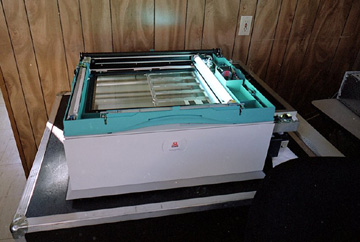
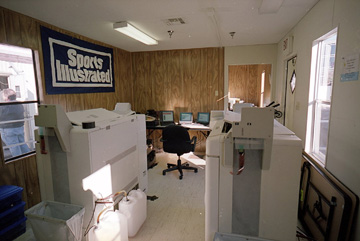
  • The choice of Rivera as the ALCS MVP was just obvious, and well-deserved.
  • It’s a shame that Pedro stuck around for the eighth; in the blink of a managerial eye, a masterful Pedro victory turned into an unfortunate afterthought. (Well, we’ll see how much of an afterthought it is in the Boston press tomorrow.)
  • Hey, Tim McCarver — could you possibly have been more annoying about whether or not it was going to be the end of Roger Clemens’ career? I’m pretty sure that we all got it the first twelve times you said it; we probably didn’t need the other fifteen hundred.
I know that it comes as shocking and totally unexpected to everyone that Verisign plans to reinstate the service that redirects any and all requests for nonexistent .com and .net domains to a page of advertisements. I’ll acknowledge that a huge part of me feels the same bile rising in my throat that floods forth every time I think about the fact that a huge chunk of the Internet is controlled by a company comprised of a thousand drunk anencephalic monkeys. But there’s also a cluster of neurons in my brain that hopes that Verisign does start Site Finder back up, so that ICANN can yank the .com and .net domains out from the control of the incompetent buffoons.

I’ve been sitting here in the fellows’ office at my hospital waiting for a lecture to start (and watching the MLB.com GameDay applet for the Yanks/Red Sox game), and just witnessed the funniest, stupidest interaction with technology ever.

One of the upper-year fellows was trying to print something, and the printer wouldn’t have any of it. She thoughtfully examined the display on the printer (“82 IO ERROR”), and then turned it off and back on. She tried to print again, but zippo happened. She then took out the paper tray, emptied half the paper, put it back in, and tried to print again. Shockingly, nothing happened. She then turned it back off and on. Nothing. Next, she turned it off and on about twenty times in rapid succession; again, the printer spit out exactly zero pages of her document. She then pressed every button on the top of the printer, all to no avail. After that, she hit the printer — hard — with only a sore hand to show for her effort. Finally, she ripped the plug out of the wall and stormed out of the room.

That’ll show the printer!

What a night of baseball! First, the Yankees’ other 40-and-over pitcher, David Wells, got it done in Fenway Park, pitching seven innings and striking out five. Then, the Cubbies learned that the Curse of the Billy Goat is alive and well when one of their own fans grabbed a ball from above the outstretched glove of Moises Alou, preventing the second out of what turned into an eight-run Marlin eighth. (Poor guy had to be scooped out of his seat by security, and later escorted out of the stadium, so that other fans couldn’t kill him.)

Of course, the Marlins win pushes the NLCS to the seventh game, which means that the Yankees/Red Sox game will be at 4:00 today… when I still have at least two hours left at work. Dammit!

I know you were all just aching to post comments and whatnot, but alas, that ability was hosed here today. (And here, and here, and here.) The reason? Because last night, I was foolish enough to accept a security update to the perl installation on my RedHat Linux box. I’m sure that the update rendered my machine more secure, but it also rendered every single perl script on the machine — including Movable Type — completely unusable. Trying to solve the problem led to a ton of other totally self-recursive problems, like perl not allowing me to install modules because those same modules weren’t already installed. It made for hair-pulling annoyance. In the end, I just downloaded the newest perl source code, recompiled from scratch, and installed what seem to be fifteen dozen modules in order to get everything back up and running. Crap like this is so annoying, so time-consuming, and just so idiotic. Could you imagine if you had to go through the same crap every time you wanted to install an app on your desktop machine?



My summary of tonight’s Yankees/Red Sox game:
  • Roger Clemens had early problems with control, giving up three hits and two runs in the first fifteen pitches. Luckily, he settled down, finishing after six innings with no more runs and seven strikeouts.
  • The Yanks scrapped away as they always do, turning gap shots and long low balls into runs. And with the only home run of the game, Jeter literally silenced Fenway Park; I don’t think I’ve ever heard the crowd that silent.
  • Pedro Martinez reinforced his reputation as a headhunter, hitting Karim Garcia in the fourth and then yelling further threats about throwing at batters’ heads into the Yankees dugout.
  • After a not-even-close pitch up and inside, Manny Ramirez inflamed already-smoldering tensions by strutting out towards the mound, causing both benches to clear and Pedro to lose even more friends by throwing 72 year-old Don Zimmer to the ground.
  • A moronic Fenway groundskeeper felt that it was a good idea to jump into the Yankees bullpen during the ninth inning, somehow leading to Karim Garcia getting injured. (Can you say criminal charges? Can you also say unemployed?) (Update: it appears that it may have been the Yanks responsible for the bullpen fracas; we’ll see where the fallout ends up.)
  • Mariano Rivera was, as always, just awesome. It’s just unfathomable that he has a postseason ERA of 0.74; during the playoffs, Mariano regularly gives the Yanks two solid innings in which all they have to do is concentrate on putting more runs on the board.
All in all, neither of the two superstar pitchers was all that awesome, and Pedro ended up losing the matchup both on the scoreboard and in his jackass behavior. (And for those who don’t know, there’s a reason Don Zimmer was bridling at Martinez pitching at people’s heads. In 1953, Zimmer was hit in the head, and was unconscious for nearly two weeks. He couldn’t speak for an additional four weeks, and he ended up with a metal plate in his head. Three years later, his season was ended by another pitch to the head that broke his cheekbone. In other words, he knows of which he speaks.)
Honestly, in the wake of pretty clear evidence of the Catholic church shuffling around pedophiles for years, does the Vatican really want to start another controversy by sending bishops and cardinals out there to claim that condoms are permeable to HIV? More than asinine, it’s just unconscionable, spreading lies and exposing people to an uncurable condition for the sake of religious zeal.
It figures that, on his own damn birthday, Matt Haughey gives us a present: Ten Years of My Life. It’s a website on which Matt plans to post a daily picture… for the next ten years. Happy birthday, Matt, and thanks for the promise of much more to come!
Oh, for the love of God… a group of parents in Oak Park, Illinois are suing their school district over the deployment of wireless technologies to connect the schools and provide network access within the schools. They are claiming that wireless networks are dangerous to the health of their children, and want the networks taken out of service. Am I really to believe that none of these parents have cellphones or cordless phones? That they never used wireless baby monitors? That they’ve never stopped off in a Starbucks to grab a cup of coffee, or set foot in an airport, or an airplane? That they’ve never used a GPS navigation system? Are all these parents going to disallow their kids from going to any college that has a distributed wireless network? A few other tidbits about the attempt to get wireless banned in Oak Park:
I gotta say, the worst thing about watching the Yankees-Red Sox games is that goddamn car zoom sound that all of the Fox on-screen graphics make. Seriously — in the last minute, there have been eleven effects that made the little zoom sound. Wouldn’t you think that they’d realize the freaking car sound is only within spitting distance of acceptable during Nascar broadcasts, and that even then it’s seriously debatable?
And there you have it; the most one-sided rivalry in sports now takes center stage, starting Wednesday night. It’s a shame that it looks like the pitching lineups won’t get Roger Clemens and Pedro Martinez on the same field, but it does seem likely that Clemens will be pitching in Fenway Park one last time in his career, which is just awesome.

Imagine that someone out there goes and signs up for a web-based fantasy sports league, and when asked for his email address, decides to make one up. Imagine that the made-up email address actually exists, though; furthermore, imagine that immediately upon submitting the “fake” email address, that scoundrel’s login information to the aforementioned fantasy sports league is sent out to the all-too-real person at the other end of the address. Now, imagine the annoyed recipient of the information deciding to log into the fantasy league website, and sell the entire team of the person who decided to not use his own email when he signed up.

I’m just saying…

For those who haven’t grown so irritated by junk email as to seize at the mere thought of it, the Boston Globe Sunday magazine has a good article by Neil Swidey on the history and the future of the fight against spam. Sitting here with 1,980 messages collected in my spam folder since the Friday morning, I can see why the mainstream press is starting to talk about the problem. I’ve wondered something, though — with the email addresses of most members of Congress available online, do you think that there’s a spam filter running on the House and Senate mail servers? If so, is there someone who trawls through the filtered messages, making sure that email from constituents doesn’t get thrown in the can?
I know that anyone who’s anyone has pointed to this over the past week, but Trevor Blackwell’s homemade Segway scooter is just the coolest damn thing. Reading through his narrative, it’s clear that you’d need a pretty good handle on your physics in order to build one yourself, but it’s also clear that if the Segway’s popularity takes off, it won’t be hard for a slew of similar products to make their way to the market.
After a few good years of service, my TiVo has finally died on me. Specifically, the modem has died, meaning that the little “Dialing…” spinny ball just keeps spinning and spinning and spinning, all the while never even grabbing the phone line. I’m at the point where television without TiVo is pretty much unthinkable, so now I get to go out and buy a new one, as well as fork over the money for the service plan. (It’s pretty irritating that the “lifetime service plan” for my current TiVo dies alongside the machine… I guess that’s how they make their money, though.) Since I’m still convinced that TiVo is the brand to get, I guess I’ll partake in the current $50 rebate; I’m just pissed that I didn’t take advantage of the offer to transfer service to a new box when I the promotion was running back in March.) Anyone have any better ideas?

Oh, for the love of f!*@, can we really not do anything about telemarketers? Looks like all we’re left with is the advice Dave Barry gave us — calling the American Teleservices Association as often as possible at the toll-free (to you, but not to them!) number (877) 779-3974 — and giving telemarketers a piece of their own action.

Update: it appears that the ATA has changed its number! The new number is: (866) 500-4272. How funny, though, that they changed their number, something that the millions of people that their members annoy really don’t have the luxury of doing…

Damn, this is cool: Recall, the new full-text search engine from the Internet Archive. What’s so cool about it? It searches all the pages of the Internet Archive, meaning that it will return hits from sites that haven’t existed for nearly a decade. Worth playing with when I get a little bit of time…
Two awesome new weblogs about journalism and the press: CyberJournalist.net and PressThink. The former’s out of the American Press Institute, and the latter’s a product of New York University; both of them are going into my bookmarks bar so that I can spend time digesting what they’ve got to offer.
Now that Shannon is going to stay in Boston (did we mention that Shannon took a job in Boston?), we’re planning on turning the room at the back of the apartment into her study and crafts room. And rather than stringing a cat 6 cable all the way from there to the front of the apartment (where the T1 comes in), we’ve decided to do the wireless thing for her computer. Unfortunately, this is an old house, with plaster and lathe walls, so the WiFi signal really starts to wheeze a bit back there. I started researching stronger antennas, and eventually settled on a HyperGain 8 dBi Range Extender. Of course, in between I found a ton of confusing information and terminology. It took a bit of hunting around, but I finally found a few good references, and now I present them for you: Now, the next step is to get all of Shannon’s stuff out of storage in South Jersey…
(Warning for the geek-averse: the following post will, undoubtedly, bore you to death.) This weekend, in an effort to better handle the ever-increasing tide of spam that’s been flowing into all the inboxes I host on my mailserver, I set up a second Linux box to do all the mail filtering. (SpamAssassin has a pretty snazzy mechanism that lets you offload the spam checking work onto a different machine as the mail server.) After getting the client/server stuff up and running, I figured out that there were a few users that would end up using the spam stuff on both machines (the mail server and the filtering server); this meant that each user would end up with two entirely different SpamAssassin preference files, as well as two different Bayes databases. And this all led to figuring out how to set up NFS shares, working through each machine’s firewall, so that this could be avoided. Fun fun fun. Here are some pages that I found particularly useful in this grand endeavor:
  • The Linux NFS How-To, which (like most of the how-tos) is a simple step-by-step walk through setting up both sides of an NFS connection.
  • Some information about autofs, which has the potential to make life a lot easier.
  • Configuring NFS under Linux for Firewall control, which goes through all the changes that have to be made to various configuration files in order to get NFS to behave in a firewall-friendly way. (It doesn’t speak to how to get RedHat 7.2 to use a version of rpc.lockd that is willing to bind to a predefined port; that’s an exercise for another day.)
  • iptables options, which is one of the best translators of the gobbledygook that’s part and parcel of Linux firewall configuration.
  • FileThingie, a one-script PHP installation that lets users edit text files via the web. I’m using this to let one of my friends make changes to a few of his preferences files (including his SpamAssasin configuration).
It’s a cool setup, and it’s working beautifully.
My brother came to visit this weekend; he’s my only family member who reads this site, and as a result, he’s my only family member who really knows how pathetic my exercise attempts (or lack thereof) have become. This morning, he dragged me out for a trek in and around Boston, him running and me on rollerblades, and we had an awesome time. We hopped into the Emerald Necklace in Brookline, made a beeline for Back Bay, crossed the Harvard Bridge (all 364.4 smoots and an ear of it), cut in along the Charles all the way to the Weeks Footbridge, came back across to Boston, and then backtracked all the way home. It was the perfect day for it, too, with perfect temperatures and a nice breeze to boot. Maybe I should take up exercising again…
The two best first-person accounts of yesterday’s blackout in New York City: Grant Barrett’s and Amy Langfield’s. Good stuff.

How do you think the millions of New Yorkers who are still without power feel about the fact that, while Mayor Bloomberg and Con Ed are asking everyone who does have power to conserve it until they can get everyone up and running, Times Square appears to be all ablaze with its standard neon lights, video screens, and electronic tickers?

The graph of the day, courtesy of Berkeley (click it to see the whole thing):
blackout graph
(By the way, George W. Bush, President of the United States, just applauded the way that people are handling “this rolling blackout.” Is he really unaware of the difference between blackouts and rolling blackouts, such as the fact that rolling blackouts are put into place specifically to avoid fiascos similar to what happened today?)

Wired has a fantastic article in the upcoming September issue on the exploding field of manufactured diamonds, and the threat they pose to the De Beers stranglehold on the industry. One of the main points of the article revolves around whether or not people (specifically women, if you read the subtext of all the quotes) will accept man-made diamonds as equal to their earthen-born counterparts; I think that the more interesting question is whether or not diamonds will fall from their absurdly elevated prestige once the artificial scarcity holding them there is shattered.

On Tuesday, I started as the fellow for the inpatient peds oncology floor, which means that in the onslaught of work, I totally forgot to say congrats to the people at SixApart for the release of TypePad! I’ve been putzing around with it a little bit in beta form, and it’s fantastic, so much more capable than anything else out there, well worth the monthly costs. Go use it!
Am I the only one that finds it a bit weird that CNN is carrying AP stories on how to avoid getting caught sharing music online? It seems that CNN’s parent company, AOL Time Warner, would want to discourage that sort of thing…
I dunno — perhaps there’s a compelling argument out there somewhere for not exempting anyone from having to go through the metal detectors at government buildings.
I thank the editors at The Morning News for passing along a link that finally makes sense of the many layers that sit between a bottle of wine and your lips. It’s amazing to me how convoluted and arcane the laws are that govern importation and sale of alcohol; it’s even more amazing to me that the entire three-tier structure of alcohol control is based in the grant of state power contained in the 21st Amendment to the U.S. Constitution. Of course, the Internet has challenged the logic of the rigid distribution network, and even more, has brought about efforts to fight it in the courts. Given the roots of the scheme in the Constitution and its taxation value to each individual state, though, it’ll probably be a long time before there’s any real change seen by consumers.

It’s only in its sixth day of life, but I gotta say that Matt Haughey’s PVRblog, a weblog devoted to TiVo, ReplayTV, and other digital video recorders, is already a damn fine daily read. Matt has already published a few longer pieces that are aimed at helping people through the harder parts of more advanced setups (like putting a TiVo on a network, rather than using a phone line), all interspersed with news and updates from the PVR world. If you’ve got a PVR, or are thinking about adding one to your life, I’d recommend a visit to the site.

Jenny Everett, a Popular Science staff writer, decided to call the Dockers customer assistance line to ask for more details about the company’s claims of a nanotechnology basis for its new Stain Defender line of clothes; the resulting conversation was pretty damn funny.

According to today’s New York Times, the White House has enacted a new e-mail system that makes it significantly harder for people to jot off notes to the President (and, one would imagine, many other top elected officials). Instead of simply addressing an e-mail to president@whitehouse.gov, now people have to negotiate nearly a dozen web pages, choosing from restrictive pre-selected subjects and indicating whether or not they agree with the present stance of the White House on whatever issue concerns them. (Note that I’ve been trying to verify the claims of the Times article all morning, but the new website and the site it redirects to have been down pretty much since I got to work.)

On the good side, the process apparetly does include a verification step — once an e-mail is sent to the President, a confirmation is mailed to the original sender which includes a mechanism for proving that that person was the author of the e-mail. That’s the sort of thing that is probably important, given that the from line of e-mail is too easy to forge, and there are plenty of reasons it’s important to know whether or not letters to the Chief Executive are legitimate.

And on the funny side, as seems to be the case lately, the Times could stand to do a little digging before choosing who to use as an article’s prime source. Tom Matzzie, the AFL-CIO organizer mentioned in the third paragraph as one of the first people to discover (and be affected by) the new e-mail system, is described towards the end of the article as “a professional Web site designer.” Elsewhere on the web, Matzzie’s involvement with the AFL-CIO is described as its Online Mobilization Manager, its Internet communications manager, and the organization’s webmaster. Given that the article’s entire purpose is to complain about the new, restrictive forms-based approach to communicating with the White House, wouldn’t it be relevant that Matzzie’s own website has an incredibly similar, and similarly cumbersome, forms-based “Contact Us” page?

I just started playing with TypePad a little bit, and I have to say, I love the photo album stuff. And with that, my first TypePad photo album awaits, and I’d be willing to bet that a few more albums will follow over the next few days.
While I’m as much for quiet cars and restrictions on cellphone use in trains and planes as the next guy, I also think that a few people in this Times article could do themselves a whole heap of good with an iPod and a pair of noise-cancelling headphones…

It’s decently obvious that the United States has now hit its saturation point of mobile phone dealers. Walking around the Arsenal Mall last night, I was struck with how many dealers were crammed into a small space. In one particularly hilarious fifty-foot stretch, there were two T-Mobile vendors as well as an actual T-Mobile store, and likewise, there were three or four AT&T dealers, a Nextel booth, and two Cingular shops. Not a single one of the booths had a customer at them, and of the stores, only the T-Mobile one had anyone other than employees in it. It was a bit of a joke, and it made me wonder when one of the cellphone providers will get wise to this and decide to cut out the third-party dealers, as well as the markup that their presence adds to the cost of cellphone service.

Shannon and I have returned to New York City for the weekend, and getting out of the new Boston apartment for a few days has provided enough perspective on the past week to allow for an update.

First and foremost, this past week has been a lot tougher than I ever would have thought, mostly because of the amount of work that Shannon and I have had to do in the new apartment. When I signed my new lease, my landlord and I figured out that there wouldn’t be a lot of time between residents. I agreed to take on a lot of the normal between-rentals work myself, after I moved in, if my landlord would handle one huge task: ripping out all of the electric blue shag carpet and decades of layered and dulled linoleum and refinishing the wood floors that lived underneath. What that meant was that I would arrive to some of the most amazing floors that I could ever have imagined, but I would also arrive to an apartment with walls that hadn’t been painted in almost a decade. I knew to expect this (and my landlord had already agreed to reimburse me for all painting supplies and expenses), but I didn’t really process how much work it would take to get it all done, nor did I predict the emotional toll it would take on Shannon and I. And despite a 24-hour trip to Boston two weeks ago to get some of the painting started and a 36-hour headstart for Shannon and her mother, my family and I arrived last Saturday to an apartment that still needed paint in almost every room, not to mention cleaning and other small maintenance projects all over the place.

Another huge fact that hadn’t even crossed my mind in the days and weeks planning for the move was that the need for painting would mean that there was no chance of me being able to unpack when I got to Boston. Needing to repaint and resurface the kitchen cabinets meant that we wouldn’t be able to unpack any of our food, dishes, or even appliances; needing to repaint the entire study (goddamn built-in shelves!) meant that all the one million book boxes would need to stay stacked up in half of the guest room. Add to it a bathroom in need of paint and minor work, a paneled hallway in need of a lot of detail work, and a few pieces of furniture that didn’t survive the move, and you’ve got a general picture of the tasks that have dominated every available minute of our past week.

The one last thing that I didn’t anticipate was the massive hit in clothing space that I took in the move. I had built quite a bit of shelf space in my huge New York bedroom closet, none of which I have in my smaller Boston closets. Similarly, Shannon’s clothes were in temporary storage in anticipation of the move, and we didn’t have any real answer for where they’d end up once they got to Boston. What this all means is that we’ve been living out of our bags for the past week, something that’s driven both of us nearly to tears at various points of tiredness.

Finally, though, it feels like we’re getting over a major hump. On Tuesday, I bought an awesome new desk, to replace the one that was decimated in the moving truck. Between Tuesday and Wednesday, we set up the major living room furniture and got cable and phones installed. On Wednesday, Shannon finished painting the kitchen cabinets and doors, and on Thursday she was able to unpack most of the kitchen and I got five of the twelve doors hung. Thursday night, the new T1 was finally brought up by my ISP. And today, we bought two big dressers that will totally solve the clothing problem.

Tomorrow, I’ll shut down all the computers that still live in my old apartment in New York (including the one running this site and the MetaFilter server), drive them up to Boston, and set them all up on the new T1. Shannon and I will then immediately set to unpacking our clothes into the new dressers and unpacking some books onto the finally-finished shelves, and I think that we’ll finally feel like we’re living in a home. I cannot wait.

Some geek-related stuff:

Things you can’t have enough of while packing:

  • Ziploc bags, sandwich-sized and gallon-sized, to pack all the loose crap in;
  • small boxes, to prevent yourself from packing too much in a single box;
  • cable ties and velcro wraps, to hold together pretty much anything;
  • bubble wrap, to protect pictures, mirrors, and electronics;
  • plastic milk crates, to carry things like plants and breakables to the truck;
  • air conditioning;
  • friends.

res•er•va•tion (1c): an arrangement to have something (as a hotel room) held for one’s use; also : a promise, guarantee, or record of such engagement.

Something I relearned today: when moving, call all the various companies you’re paying for moving day services to see if they actually intend to provide those services. In the case of moving truck rentals, their contracts are actually explicit in telling you that your reservation isn’t really a reservation of equipment, just of the price of the equipment if they have it to give you, so you have to call to ask if there’s even a chance of them providing everything you’ve asked for. Want the small equipment, like a hand truck? Find a friend with one. Want a truck? Make your reservation for the absolute earliest time the pick-up spot is open, so that you have a chance of getting the few that they will provide. If you rely on the company for everything to work out right, assume that it’ll all work out terribly; at least then, you’ll be pleasantly surprised if it doesn’t fall apart.

I cannot wait until this move is over.

What an incredible evening. As everyone is now painfully aware, my last few weeks have been jam-packed, planning for the move, finishing up at the hospital, and working on my custom content management system. All this time, tonight has been reserved on our calendars as a break, ostensibly for a dinner with Shannon’s parents and some of her father’s colleagues. Thus, we got all gussied up tonight — Shannon wearing, for the first time, a piece of clothing that she had knitted — and headed out to Dos Caminos. Imagine my face when we wound around all the tables and into the very back to find her parents sitting with my entire family and a bunch of my closest friends, all in a surprise party to wish me an early birthday, congratulations on finishing residency, and good luck on the transition to fellowship in Boston. I can honestly say that I’ve never, ever been as surprised. It turns out that Shannon, my sister, and my mother have been working since January to put this together, and it showed; there were hand-dyed name placards, custom menus, and a framed invitation in the middle of the table with a photo of a 1975 version of me blowing out my birthday candles. I had a fantastic time, received gifts both thoughtful and memorable, and left feeling like there was nothing I could have done to deserve that celebration. I’m glowing tonight, a little sadder about leaving everyone, but happier that I have such a close group of people in my life.

Is it rational for me to feel like a loser because there’s absolutely no evidence that the MSNbot knows of this website? Could it be that the new Microsoft search crawler knows about the lethargic rate of posts here as of late, and is merely acknowledging my sheer boringness?

It came as a pretty cool discovery to me this week that SpamAssassin has made its way to the world of major university mail servers. I’m the first to acknowledge that today’s filters aren’t a panacea for the ever-worsening unsolicited e-mail problem, but doing nothing hasn’t been a raging success, and legislating the problem away seems to be both improbable and impossible given the reality of the Internet. I’m hopeful that, as mail filters are implemented by larger and larger mail providers, they’ll get better, and they’ll also help everyone involved discover even more effective ways at getting to the root of the problem.

Five simple words: San Antonio Spurs, NBA champions. What a great way to send David Robinson off into retirement, and for Steve Kerr to win his fifth ring. And finally, my blood pressure is returning to normal.

Last night was my final 24-hour call in the hospital (a fact I didn’t realize until about 1 o’clock this morning). The milestones are just stacking up; next in line, my last class retreat (next weekend), my last clinic (two Tuesdays from now), and my last overnight call in any capacity (three Wednesdays from now). In the mean time, though, I’m off to Boston for one day of geekery before returning to marking the passage of time…

Another few milestones passed: my last overnight call as the senior resident in charge (last Saturday), and my graduation ceremony (today, although there are still two and a half weeks left). It feels totally strange to be finishing my association with an educational institution that has provided the last eleven years of my education, but it also feels liberating. In three weeks, I’ll be in a completely new hospital, with a completely new ethic, learning completely new medicine. I’ll have a new apartment, be driving my new car, and be further than three miles from my family for the first time in 10 years. From the start of college through now, I’ve rested on my New York haunches at every decision point, partly because it was the best thing to do in the context of each decision but also partly out of stasis. Now, I finally get the experience of totally uprooting my personal life just as I’m starting the next stage of my professional life, and once I get past the holy-shit aspect, it’s going to be a ton of fun.


I’m not entirely sure, but I just might be the target of this mockery… (Oh, and Anil, I am pretty sure that it was you who came up with the need for a docking cradle.)

suzie the subie!

Today was a very special birthday… for Suzie, a 2003 Subaru Outback Limited. (Not coincidentally, it is also my first day owning a car.) The arcane laws of the Great State of Massachusetts made it necessary to actually drive to Massachusetts to acquire Suzie, but that’s all behind me now, and tonight, she’s tucked safely into a space in a Manhattan garage. It’s a little overwhelming to own my first car (and to think about the payments that start in a mere 30 days), but all things said, I’m totally happy, and can’t wait to break her in a little bit.

Alas, it turns out that the online sharing abilities of iTunes 4 is less of an undocumented feature and more of an unintentional bug. So much for the alternative theory

How cool — a wild turkey has been making spotted appearances in the heart of Manhattan, much to the delight of residents and confusion of ornithologists. One sighting was even on a 28th-story balcony, amazing given that turkeys aren’t very good at tackling vertical distance. And people say that you need to leave New York City to find the great outdoors… (Thanks to Noah for the link!)

Re: The Matrix Reloaded, I’m right there with Philip Graham. Seriously, I have nothing more to add to his review; it’s spot-on.

Wow — a Manhattan judge ordered New York’s transit authority to roll back last month’s 50-cent fare hike within two weeks due to dishonesty in the process used in helping justify the hike to the public. Apparently, the MTA hid money off the books by shifting it into future annual projections, making its finances look $600 million worse than they really are. The MTA is complaining about how hard it will be to roll back all the equipment; that being said, if the allegations are true, nobody’s going to feel sorry for the predicament the agency put itself in.

Around here, things have been busy lately. As soon as I finished in the emergency room, I was thrown into the inpatient wards as the senior resident on service, meaning a return to early mornings and fourteen-hour days. And just after walking in the door at night, I’ve been heading straight for the laptop, getting down and dirty with code as I craft a content management system for one of my web projects in the hospital. With Shannon in the middle of her finals, we make quite a couple, tiredly collapsing into our respective ends of the sofa and communing with our computers until the wee hours of the morning. All in all, it’s enough to form the framework for a new reality video, “Overextended Dorks Gone Wild.”

That being said, I’m really enjoying my work. The web project is allowing me to finally pick up a language I’ve wanted to use for years, and get off of a CMS backend that I absolutely despise. It’s also letting me play with workflow design and systems architecture, which may not sound exciting, but which makes my brain feel right at home. And importantly, the project may actually earn me a little money — something that I welcome wholeheartedly, given that my looming move to Boston is already taking a bite out of my bank account.

In the hospital, as the only third-year resident on my inpatient team, I’m getting a great chance to see how much I’ve learned over the course of the last few years. What took me hours of reading and contemplation two years ago is now second-nature; a kid who could instantly drive me to panic as a first-year resident now drives me to start delegating tasks and taking action. (It’s even been enough to push me into starting a new pediatric arrest curriculum for the hospital, which has unquestionably been the most satisfying thing that I’ve been involved in thus far.) I now have only six and a half weeks left as a resident, and while I only feel like I’ve been a pediatrician for fifteen minutes, those fifteen minutes feel like they’ve been jam-packed with great learning, awesome kids, and more rich experiences than I would have ever believed possible.

I’ve never been one to handle idleness well, quickly finding something to fill any gaps in time or commitments. These last two months in New York promise to be busy as all hell, but I don’t think I would want it any other way.

Two views of my apartment building, separated by almost a century:

April 2nd, 1909

April 2nd, 1909

May 4th, 2003

May 4th, 2003

The first picture comes from a print I found at the Columbus Avenue Flea Market this afternoon, making me one of the happiest people walking the streets of New York today. I bought four other prints, as well — one of the intersection of Broadway and 96th Street (taken during the construction of the subway in 1903), one of Columbia University’s Washington Heights campus in 1905 (when there were only five or six buildings on the site), one of Hilltop Park in 1905 (between 165th and 168th Streets on Broadway, the home of the New York Highlanders), and the last of my hospital building in 1931. Leafing through all the historic photos of New York made me remember that there’s a lot from of late 19th- and early 20th-century New York that’s still standing, and it’s what makes this city so amazing to me. I’m going to miss exploring New York’s history when I leave; I guess it’s time to start exporing Boston’s history.

(Update: Anil made a neat animated GIF of the two images.)

If you’re a New York state resident and have experienced problems with VeriSign — problems with the company screwing you over with domain name registration, or any other problem with its business practices — you might want to head over to Mike Wasylik’s site and help the good New York Attorney General out with an investigation into the company. (Mike is involved because he has served as Leslie Harpold’s lawyer in her inquiries into how her domain name, hoopla.com, was stolen out from under her.)

Wouldn’t it figure, just as I’m fixing to leave New York City, plans are firming up for a loop around the island of Manhattan for bikers (and, of course, rollerbladers). The grand scheme is called the New York Greenway, and aims to link up the disparate pathways that are currently chock full of people trying to get exercise. Parts of the loop are already open; Friday, I discovered this when I got to the south end of Riverside Park and was able to continue on a connection to Hudson River Park. Happily, Alaina and I were able to go all the way to Battery Park, and ended up with 15 miles on our blades. The route took us past the 79th Street Boat Basin, the U.S.S. Intrepid, Chelsea Piers, the New York Trapeze School, the World Financial Center, and the former site of the World Trade Center towers before turning around to come back to the Upper West Side. Had we continued northward, we’d have been able to get (with one major diversion onto city streets) to the George Washington Bridge. What a great way to get some exercise!

Finally, New York City’s new 311 call center is getting a little bit of press. I had the chance to talk with one of the developers of the service at a party a month ago, and learned that it came about as a result of our current mayor walking down a street during his campaign and noticing a fire hydrant leaking into a basement. He asked his aides who the owner would call to get the problem fixed, and was given a variety of possibilities — the fire department, the buildings department, the landlord of the building — and then when he learned that the real answer was the Department of Environmental Protection, he decided that there needed to be a centralized way for a NYC resident to get answers like this, not to mention to take care of the problems themselves. The city brought 311 online on March 9th, but didn’t advertise it at all, instead allowing agencies to start directing calls its way as their functions were centralized. And most interesting to me, any issue that isn’t completed by the end of the phone call is issued a tracking number, allowing callers to get status updates on the solutions to their problems. Bloomberg’s invested a lot of time and money in creating the 311 service, and it looks like it could revolutionize the relationship between NYC government agencies and their constituents.

(One interesting factoid: 212-NEW-YORK is the phone number people would use to access 311 outside of New York City. Cool!)

In what can be seen as an indication of just how big the problem has become, the war against unsolicited email hit the front page of the New York Times today. While not a terribly detailed article, it goes a little bit into the cat and mouse game that spammers and Internet service providers play on a daily basis, and talks about a few of the options that both ISPs and end users have employed trying to stem the tide. It also provides a few overwhelming statistics, such as the fact that 45% of email headed into Earthlink’s mail servers is now junk, and over 70% of that inbound to AOL is unsolicited. (We’ve all had a hint of this huge surge, both from the increasing numbers in our own inboxes and from those who keep us informed about how much crap ends up in their inbox.) The most frequent defense proffered by spammers is that the absolute most they’re forcing users to do is hit the delete button, but these numbers are this argument’s best refutation; there is a hell of a lot of network and hardware capacity that currently has to deal with email that nobody requested and nobody wants, and it’s all paid for by the unwilling recipients in the form of higher access and hardware costs. Luckily, as the numbers continue to rise, and corporate America continues to find itself buried under masses of unwanted email, lobbying for legislative solutions can only become more effective. Until then, though, I recommend continuing to make the spammers’ lives hard on both a business and personal level, by using collaborative mail filtering services, participating in projects that are able to continually adapt to the tactics of the spammers, and engaging in one’s own alternative solutions.

(Incidentally, I’m proud of the Times author for using the domain name example.com in his explanations, since it’s reserved for just this purpose. Too many other people choose random domains for their examples, leading to a lot of spam in the inboxes of the legitimate owners of those domains.)

I’ve spent the last few weeks looking for a good, inexpensive content management system, one which could serve as a replacement for the inadequate, buggy platform on which a project I’m involved in runs. I’ve installed about two dozen of the options out there, and evaluated twice as many more , and I have to say that there’s truly nothing inspiring to speak of. Nearly every CMS is built on its own confusing, overengineered foundation, and as a result, they all build equally confusing and overengineered websites. In addition, most of the CMSes focus too much on specialized features rather than generalized content management, incorporating modules that add weblogs, shops, bookmarks, Google searches, P2P messaging, photo galleries, polls, and advertising banners, among many other things. And then, to top it all off, pretty much none of the CMS options have documentation that’s worth a damn, making it that much harder to figure out the workflow and structure of the data representing the all-important content.

After seeing so many recurrent issues, I’m starting to believe that they’re not problems with the products, but rather, problems with the entire idea of content management systems that are applicable across projects and industries. Vignette may be great for news sites, but it doesn’t hold up as a medical database; Slash works out well as an online forum, but it’s a poor fit for a photo gallery site. The site I want to move is specialized in its own way, as well, and finding a CMS that works for its purposes without forcing users to jump through unnecessary hoops is proving to be immmensely difficult. Thus, I’m now at a crossroads: keep looking and thinking about how to work around the structure of a CMS, or decide to build my own. Maybe the latter option is the best, acknowledging as it does that there’s no such thing as a content management system that can manage every single website.

What an awesome picture! It always makes me happy to see the photo wires move images that give a story a little bit of color.

Wow, do I want me a Leica D-Lux. Over three million pixels on the CCD, a Leica-fabricated lens with 3X optical zoom, an aluminum body, unlimited video time, USB 2.0, and two lithium ion batteries — it’s an amazing package, and it very well may replace the Leica Digilux 1 as the digicam I would least mind seeing show up on my doorstep. (And if my impending graduation from my pediatrics residency isn’t reason enough for someone to send it to me, then I don’t know what is!)

If I’ve learned anything over the past ten years about rollerblading in Central Park, it’s that your level of enjoyment is directly proportional to your powers of anticipation and forecasting. Stated more succinctly: while whizzing around the loop, it’s important to keep your eyes open and be aware of everything that’s going on around you. Is that couple walking to the Boathouse going to get all the way across the loop before you reach them, or should you start figuring out a path around them that minimizes your loss of momentum? When you reach that clot of people extending all the way across the exercise lane, will their relative speed differences have created a manageable path through the blockade, or should you be looking for a spot to hop onto the sidewalk and zip right by them? Is that woman walking with the stroller going to continue to weave around on the roadway, and if so, are you both destined for the same patch of asphalt at the same time? (Alternately, is that woman with the stroller going to suddenly realize that the big, paved sidewalk immediately inside the loop was built so that people wouldn’t stroll in the exercise lanes of the roadway?)

And if that’s all not hard enough, there are certain times during the day that Central Park is open to cars, meaning that venturing out of the third of the road limited to bikers, bladers, and runners is an invitation to become either a hood ornament or road kill. If you’ve ever crossed an intersection on foot in NYC, you know that the likelihood of anticipating the future path of a cab is similar to that of hitting the Powerball; when you’re traveling 15 miles an hour on an unstable base of inline wheels, and the line separating you from the cab is only four inches thick, doing so takes on a whole new level of importance. Is that cab going to use the exercise lane to pass that Parks Department truck he’s been riding tight for a quarter-mile? Do you need to speed up a bit to get across the 72nd Street transverse, or will you reach it at the same time as that stream of cars, forcing you to stop and wait?

All in all, rollerblading in Central Park is a great way to exercise, complete with beautiful views, great places to rest, and the everpresent chance to spot celebrities. But if you’re the kind of person who likes to tune out while you sweat, then it may not be for you; self-preservation requires you to stay on your toes.

Listen, all you downtown snobs, you can say what you want about my Upper West Side, but I’ll just stay quiet up here, content in the knowledge that you’re all fatter than us.

No matter where you weigh in on the current conflict in Iraq, I recommend reading Eason Jordan’s op-ed piece in today’s New York Times. It’s a powerful demonstration that the presence of free world media over the past decade in nations like Iraq hasn’t necessarily meant the exposition of the atrocities that take place in those nations; basic human empathy, at the level of those in charge of the news bureaus, has intervened to protect those most vulnerable to retribution. (Of course, that fact also leads me to wonder what we don’t know about in other similar nations, like China.)

So, I was in the back of a taxi this evening coming up Amsterdam Avenue, and at 72nd Street, I decided to open up my laptop and see how many wireless access points were visible along my trip. Between there and 120th Street, I picked up 180 WiFi nodes; only 48 of them (27%) were WEP-protected. Of course, there’s no telling how many of them were willing to dole out an address to me, nor how many of them had filters preventing random computers from connecting, but that’s still damn impressive, and way more access points than I would have thought I’d see. There were plenty of interesting nodes, too: a bunch for Columbia University, one at St. John the Divine, one in a New York City Housing Authority building, two NYCwireless nodes, and one beaming out the bedroom window of a certain Filipino broad. There were also a dozen or more powerful nodes named TBA; I wonder if there’s a wireless project in the planning.

Nonetheless, if you’re looking to cop some free wireless access in New York City, I’m pretty sure that you can just set up shop at any of the sidewalk cafes along Amsterdam Avenue and surf away!

Whether or not you believe that elephants can actually run, one fact that’s now beyond debate is that, while moving quickly, pachyderms never have all four feet off the ground at the same time. While conducting a modern-day variant of Eadweard Muybridge’s famous 1878 horse experiments, John Hutchinson also clocked the huge animals at nearly 16 miles an hour (five miles an hour faster than his previous estimates). His findings were accepted for a brief communication in the journal Nature; there’s more information over at Hutchinson’s website, including the article itself (in PDF format).

There’s an interesting article in the New York Times about the closure of a few movie theaters on the Upper West Side of Manhattan, going into a lot of detail about the history of all the movie houses along Broadway, and the tough roads ahead of smaller theater owners as they, like all New Yorkers, face gentrification and the higher real estate prices that go along with it. I imagine that Manhattan has always been like this, with the push and pull of society and the economy doing a lot to determine the content of this itty bitty island; it’s amazing to me that any small businesses still find themselves able to afford setting up shop in the city. I just hope that Manhattan isn’t becoming one huge strip mall…

I don’t know why, but I think it’s so damn cool that Kareen Abdul-Jabbar and Bobby Hurley are actively pursuing the head basketball coaching position at Columbia University. The word in the press corps is that neither are likely finalists for the position, but still, it’s nice to see that Ivy League basketball is still considered a worthwhile pursuit at the coaching level.

Doesn’t it just seem logical for NASA to gather photos of orbiting space shuttles from military satellites? The NASA and military people quoted in the article imply that the image quality won’t be quite as good as we’d all assume, but that just doesn’t seem honest. It’s relatively well-known that the current generation of commercial imaging satellites have sub-meter resolutions back to the surface of the Earth, and fair guesses place the resolution of U.S. reconaissance satellites at somewhere less than four inches. Now, move your target a few hundred miles above the ground — and above the distortion of the atmosphere — and I feel confident guessing that the military’s best satellites would be able to show you the expression on an astronaut’s face. And if images from the satellites provide options for shuttle controllers in the event of in-flight problems, then that’s a major plus for the space program.

Something interesting and new to play with: Fotonotes.net. It’s a tool that allows you literally to annotate your images (well, JPEG images), providing information about the content of the pictures to people who are viewing them. It’s sort of like captioning them, but within the image itself; the information is only visible when the viewer wants it. (Dan Gillmor explains the technology a little better than I do.) The fact that it only works with JPEGs, and that the information is actually written within the image file itself, leads me to believe that the tool uses the IPTC metadata standard. If that’s the case, then there are a ton of other tools that should be able to read, if not manipulate, the information as well.

In a move that surprises nobody, AOL Time Warner is pulling free content from all its magazines’ websites, starting this weekend with People and Entertainment Weekly. Between AOL’s first-ever quarterly loss of customers and all the talk about how it’d make sense for Time Warner to dump the Internet service on its ass, it makes sense for AOL to leverage the content of the Time, Inc. magazines in order to get its subscribers back. It remains to be seen, though, whether anyone feels that People and EW offer unique enough content to justify shelling out $25 a month for a dialup provider…

We’re back from Puerto Rico (well, I’m back from Austin and San Antonio and Puerto Rico, and Shannon from the latter two), and it was an amazing trip all around. Good old and new friends in Austin, good old friends in San Antonio, and a big block of relaxation in Puerto Rico make for a good two-week break. (And nearly as good was coming back to find out that I didn’t fail the boards, and that Lia did a bang-up job taking care of the kitties and plants.)

More on all of this later; I have to be back at work in less than 10 hours…

the texas capitol building, austin

Goodbye, Austin, and SXSW 2003; it was a fun trip. Now, onto San Antonio for a few days, and then a week in sunny Puerto Rico for drinks with tiny umbrellas in them…

I’m glad that, in this time of threatened war and a terrible economy and whatnot, our Congress is working hard. Sure makes me feel more secure about our leaders…

A tip, for everyone who’s broadcasting their unencrypted passwords over the free wireless network at SXSW: don’t, since I’ve seen at least half a dozen people capturing packets off the network just to see what they can see. If you’re using one of the big commercial web-based email services, use their secure login, not the standard one; if you are uploading files to your webserver, use secure FTP or secure copy, not FTP. Likewise, realize that Outlook, Entourage, Eudora, and most every other mail client sends your password across the network as clear as day unless you set them up to use an encrypted service (and then have that service running on your mail host). Posting to your weblog is no exception, either (unless you want the person who grabs your login and password to also be able to work on your site); set up a secure tunnel back to your weblog host, and then use that to do your posting.

I’m glad to see that Matt’s trying to get back to writing longer essays. His latest piece is a fine review of the great features that Mozilla has made users expect from their web browsers, and it makes me remember how much I have enjoyed reading Matt’s perspective on the world.

The subject matter of the piece also made me remember a conversation I had with Anil recently, discussing Internet Explorer’s lack of a popup-blocking function. We both came to the conclusion that, in this day and age of the overwhelming proliferation of popups, the only possible reason that IE omits the function is a fear that Microsoft will be somehow blamed for yet another move destined to hurt the little guy, in this case, the advertiser trying to make money on the web. (Remember when IE was the first to implement third-party cookie blocking, and how people complained that Microsoft was being unfair to advertisers?) By resting on the huge browsing majority and letting popup blocking gain acceptance (or, more appropriately, achieve required status) with other browsers, you can bet that there won’t be a peep when the next version of IE includes the feature.

There are a lot of annoying things about working the overnight shift in the emergency room, but one huge entry in the plus column is that I can walk into the bagel bakery across the street at 6 AM, just as they unlock the front door, and have my choice of any steaming hot bagel my little heart desires.

Am I the only one that finds it terrifically ironic that Time Warner has national television commercials trying to convince people that they should get Roadrunner-brand cable modems so that they can more efficiently swap music with friends?

Generally, I’m pretty content with the understanding that there are probably quite a few threats to peace and security in the United States about which the lay public never learns. (After all, it’s the premise of the most basic spy thrillers, including most of the Bond movies — a brewing plot to destroy civilization as we know it is undone at the last second by secret agents, and life continues unaware of how close it was to coming to an end.) That being said, I’d love to know why there have been around a half-dozen National Guardsmen, armed to the teeth, in the subway station underneath the hospital the last few times that I’ve arrived for my overnight shift…

If you’re the administrator of a machine that runs sendmail, there’s a nasty security problem that found its way to the surface today. Discovered by the people at ISS, the bug allows someone to compromise your machine simply by sending a specially-formatted email; firewalls aren’t going to help you on this, since it’s the contents of the email that trigger the security breach. The list of affected systems and operating systems is pretty extensive, so you might want to peruse it before assuming that you’re not vulnerable.

Rarely a day goes by that I don’t learn something else about New York City. Today’s find, via an article in the New York Times: the New York Cross Harbor Railroad. It’s one of the shortest railroad lines in the United States, with only one and a half miles of track, a bunch of carfloats, and a single active locomotive. The line serves to move railcars from Brooklyn to Greenville, NJ (which means a trip across New York Harbor); on the Brooklyn side of the water, the train actually runs along city streets in order to pick up and deliver its cargo. The carfloats meander across the Harbor once or twice a day, providing shippers who don’t want to travel the extra 150 miles to Albany with a shortcut across the Hudson River. As you’d expect, the line faces many difficulties, from double-parked cars blocking its tracks to fog in the Harbor to the dwindling resources devoted to surface freight in New York City; despite this, it continues on, providing the city with a tiny anchor to its manufacturing and shipping roots.

Today was guy’s day out in my family, our annual celebration of my father’s birthday at the Peter Luger Steak House in Brooklyn. If you’re in New York and have never been, do yourself a favor and drop in sometime; most importantly, get the bacon, which may well be the tastiest morsel of food that’ll ever pass your lips. For the first year, the girls organized a competing lunch, and afterwards, we all met up at my sister’s new apartment to ooh and aah at her latest ultrasound pictures and catch a little of the Spurs game. It was a great day, and it’s the perfect example of something I’ll miss terribly when I move to Boston this summer.

I’m glad to note that SpamAssassin 2.50 has been released, bringing Paul Graham’s now-famous Bayesian filtering idea to the world of detecting unsolicited email. The new version also brings improved rules for detecting the telltale signs of bulk mailings, as well as a better way of modifying mail it suspects is spam (it encloses the original mail as an attachment, and then changes the main message to a preview plus an explanation of why it thinks the mail is unwanted). Mostly, I’m happy that the release made it into the world at all, given Deersoft’s acquisition by Network Associates last month. Here’s hoping to continued open source releases…

I don’t think I can put into words how cool I think this project is. James Meehan strung together a helium-filled balloon, a radar reflector, a Garmin GPS receiver, an Aiptek Pencam, a ham radio, and a computer system built from off-the-shelf components, and launched it all as an amateur weather balloon. It travelled nearly 80,000 feet into the air, sending reports back the whole time; the reports contained location information, allowing James and his team to track it while it was in the air, find it when it landed, and retrieve all the pieces (including the pictures taken by the camera). He called the experiment “Balloon 1.0,” which leaves me optimistic that there’ll be a few more iterations to come.

Shannon and I snuck up to Boston last night, a planned-at-the-last-minute trip to scout out the lay of the land for my eventual move this summer. It’s too early to start looking at actual apartments, so we spent today just driving and walking around neighborhoods — Brookline Village, Coolidge Corner, Jamaica Plain, Longwood — trying to feel whether or not I could call any of them home. A lot of the dread that I’ve been feeling over the past few months about the move is rooted in the fact that I’ve built up a lot of comfortable stasis in New York; to wit, I’ve spent college, medical school, and now residency at the same institution, I’ve lived in the same amazing apartment for nearly eight years, and my entire family is arranged neatly around me on the island of Manhattan. Moving away from all that isn’t easy, so the goal of this weekend was simply to begin getting a feel for the new life I’ll be starting in July, and maybe to see that there are places here to plant a new root or two. A vibrant neighborhood, a few beautiful apartment buildings, a ride past my new hospital on the T, a great dinner with friends — today, all of these things helped me take a few steps towards being ready to get on with things. None of it makes it any easier to leave New York, but all of it makes it easier to come to Boston, and there’s nothing but good in that.

sxsw kick 2003

Thanks to Eric Lacombe, the 2nd annual SxSW kickball game has a brand spankin’ new logo. Andre Torrez recommended him to me, after the great job that Eric did on Andre’s logo; I’m happy to say that he accepted, and the game’s all the richer because of it. Go check out the loot shop, complete with shirts and whatnot with Eric’s new logo, and buy stuff to support the game!

I’m starting to get excited about SxSW 2003, if only because of all the activity in the weblog arena lately. There’s Google buying Pyra, AOL sniffing around the periphery, the debut of TextPattern, the announcement of Movable Type Pro, the promise of Meg and Nick’s collaborative Lafayette Project, and whole slew of other, smaller interesting tidbits. Now, I know that SxSW is about a hell of a lot more than weblogs, but part of my connection to the conference is through my personal site. As my medical life exerts more and more pressure on my site and database design life, QDN remains the excuse that I use to justify the amount of time I spend learning new programming languages, content management systems, web standards, and design skills. Last year, I was glad to get a chance (if only for two days) to listen to people who have worked wonders in the world of interactive media, and I feel like I came away from the conference with a good deal more knowledge, not to mention the buckets of respect for the collective intellect that’s devoted to building a better web. If all the positive energy in the weblog world this year has any meaning, I’m eager to get back to Austin this year.

(Of course, I’m also excited about Kick 2003, but that’s a post for later this week…)

I mean, I know that we were expecting snow tonight, but holy crap did it start snowing in a hurry!

the blizzard of 2003

When Shannon and I walked into my parents’ apartment tonight for dinner, it was crisp and cold out, with nothing in the air but the mist coming off our breath. About fifteen minutes later, you could make out the barest of little snowflakes silhouetted against the glare of the streetlights below; within a half an hour, the sky was full of snow, blowing parallel to the ground and getting caught in swirling eddies around the trees in Park Avenue’s median. By the time our bellies were full, the roads were covered curb-deep, and we decided to try to get back across town. Somehow, it only took two or three minutes for Shannon and my sister to flag down the only cab that wasn’t either already taken or fishtailing its way across the unplowed streets (or both). The trip back to the Upper West Side was slow going, but we went through the Park, and the view of the trees and rock walls covered with flawless snow was more than worth the time it took. And while the sidewalks of the Upper East Side were mostly deserted, those over here have a few curious souls on them, showing their children the deep snow and enjoying the magical white blanket that comes but a few times a year.

The Commerce Department announced yesterday that it was expanding the eligibility for .edu domain names to all U.S. educational institutions which have been accredited by an agency on the Department of Education’s list of recognized accrediting agencies. This means that a whole host of vocational schools — massage therapy schools, midwifery training institutions, cosmetology programs, and Montessori schools, to name a few — are joining the .edu neighborhood. The change has come with a bit of complaining, of course, mostly from the elder elite who feel that .edu should remain the province of the upper crust; a retired Princeton administrator was actually quoted on the AP wire as saying, “Somebody who goes six months to a beauty school, I would not consider in the same league as somebody who’s even been two years at a community college…. There’s too much dumbing down already.” I have to ask: are there really people who judge a person’s academic worth on whether or not his educational email address had .edu at the end? (And as if a Columbia guy like myself needed another reason to look down on Princetonians…)

I think that I’m big enough to admit to the fact that tonight, while deleting the 2600 unsolicited email messages I have received in the past 8 days, I totally failed to appreciate the irony of the three messages entitled “Tired of Deleting Junk eMail?”.

I can’t wait for there to be a tenable way to stem the tide of spam.

A few collected links about the Hudson Railyards, which was pictured behind Alison on our High Line jaunt and is the proposed site of a massive development project:

Today, the scientific part of my brain was in control at the exact time necessary to help me put my finger on what it is I hate most about the Washington Post website’s idiotic, intermittent survey: it collects terrible data.

I use many computers in the course of a week. I have a half-dozen machines in my apartment, another one at Shannon’s, one on my desk at the hospital, and two on my desk at the magazine for which I do occasional work. There are also a dozen computers on every floor of the hospital, and a dozen more computers at my outpatient clinic. Add to that the two computers at my parents’ home, the one at my brother’s apartment, and the one at my sister’s, and of course, don’t forget the umpteen public terminals out there — at libraries, airports, Internet cafes, conference centers, and hotels — that I’ve used on occasion. We’re talking about a lot of machines here, and I’m reasonably certain that the Washington Post has counted me as a 29 year-old New York City male on each and every one of them. According to their database, there are dozens of keyboard-happy Manhattan twentysomething men banging down their virtual door; their automated ad generator spends countless cycles of processor time dreaming up sales pitches for bagels with schmears, spacesaving hardware projects, and Chinese take-out. And given my penchant for reinstalling operating systems (or, at the very least, clearing out my web browser cache and cookies) every now and then, the WP site counts me again and again and again.

I used to think that the best answer was to give them false information — once an octagenarian woman from Burkina Faso, the next time a months-old baby boy from the French island department of Reunion. The survey attempts to assuage those of us who hate filling out the form over and over by promising that the survey will help them better know their readers, improve the website, and serve better ads; it became fun to try to figure out what their marketing drones were going to choose as the best products to push to 110 year-old Micronesians. It eventually became easier to just enter my real information, though, but today I came to the realization that repeatedly doing so may be the best way of all to poison their database.

Since I was nominated for a PhotoBloggie today (the Best Photo Essay on a Blog category, for the High Line pictures), and I walked out of the hospital into a surprise snowstorm (well, a surprise to me, in any event), I figured that a photo might be in order:

snowfall in manhattan

Even that picture doesn’t do the snowstorm justice; the flakes are plump and airy, slowly wafting down and in no rush to join their colleagues on the street below.

Whenever I stay at Shannon’s apartment, my morning walk to the subway takes me down a long crosstown block that has angle parking. Every single morning that I walk that stretch of Manhattan pavement, there are at least three specific cars that are illegally parked, a black Lincoln Continental that’s nosed into a fire hydrant, a maroon Bonneville that’s up against another fire hydrant, and a dark grey Cadillac-type sedan that sits in a zebra-striped loading zone. All three cars have laminated signs on the dashboard identifying their drivers as members of the NYC police force.

The short walk from my apartment to Shannon’s takes me past the neighborhood police and fire stations, and on the block, there are invariably about a dozen cars, trucks, and SUVs parked illegally — in crosswalks, against fire hydrants, double- and triple-parked, blocking driveways — all with either shields or laminated signs on the dashboards. The volume of illegal parking on the block has made the extra-wide sidewalks into valid driving lanes, used to escape parking spots that remain blocked for hours and hours; it has also caused otherwise-legal parkers to leave their car six or eight feet out from the curb, so that there’s no room for someone to illegally block them in.

I gotta say, as an occasional New York City driver, count me in as strongly in favor of the aggressive enforcement of this city’s parking laws, but make sure that the new swarms of traffic cops ticket everyone, not just us hoi polloi who don’t have a badge.

Normally, I’m not one that gets too excited about anti-war rallies, but it seems that the activist community has finally hit on a strategy for protests that has a chance of getting me out of the house. It’s marketing melded with social awareness, at its finest!

If you’re looking for a real, in-depth look at Howard Coble’s idiotic defense of Japanese-American internment camps, head over to Is That Legal (starting with the February 5th entries). Eric Muller provides informative and well-researched background on the camps, from their origins in biased research done by the Secretary of the Navy to the voices of reason that were silenced in favor of racist, reactionary politics. He also puts a good deal of work into debunking Coble’s attempt to claim that internment camps were primarily for the protection of Japanese-Americans, and sent the explanation to Coble’s office as an added bonus.

I can’t believe that this schmuck just won himself another term in office.

What do you think makes an applicant more attractive to a college, getting great grades and working hard in an internship, or having a propensity for filing lawsuits against your school demanding better grades? Does the fact that the lawsuit is over a grade given by the applicant’s mother change the answer at all? How about the fact that the lawyer representing the student is that same aforementioned mother?

What a depressing piece of news: “Even if flight controllers had known for certain that protective heat tiles on the underside of the space shuttle had sustained severe damage at launching, little or nothing could have been done to address the problem.” Of course, there’s part of me that hopes that, had NASA or the orbiter crew known about the damage, another option would have presented itself; after all, I can’t imagine that anyone would have been able to predict the sequence of events that led the Apollo 13 astronauts to survive their ordeal in space. Given the amount of national grief, it seems that had anyone known that the lives of the seven astronauts were at such risk, nothing would have been spared to get them down.

When you’re a cat, life sure is tough…

sammie, oblivious to the world

Berkeley’s computer science department has provided yet another breakdown of last week’s SQL Server worm, this one more epidemiological than technical. One of the most impressive parts of the report is a Wargames-like graphic that shows the reach of the worm in its first 30 minutes of life; there are also good graphs showing both the packet traffic generated by the worm and the rapid decline in its traffic as system and network administrators responded. (Something that particularly interests me is that the traffic analysis was done in a “tarpit” network — a network that’s used only to collect data on incoming, unrequested packets like those used in virus or worm attacks — at the University of Wisconsin Advanced Internet Lab.) One of the big lessons to take from the data is that, with a rate of spread that quick and a penetration into networks that deep, a more malevolent worm could cause a hell of a lot of damage.

Since most of the new coverage of the Columbia disaster is perseverating on potential causes and the presence of the first Israeli astronaut, I’ve been surfing in an attempt to find out more about the mission. One thing I discovered that’s of interest to me is that STS-107 was possibly the last pure science mission for the Space Shuttle program in the forseeable future. As I mentioned earlier, Columbia was the first, and heaviest orbiter, and prior to its rehabilitation over 2000 and 2001, it was unable to reach the orbit of the International Space Station, and was perfect for science missions. Now, the future schedule for the Shuttle program is packed with ISS contruction missions, and science has mostly been displaced.

There were over 80 scientific experiments aboard Columbia, all of which were designed to exploit microgravity in the study of how cells, flames, organisms, magnets, and basic human biology operate. In addition to the crew, there were rats, garden orb weaver spiders, silkworms, fish, carpenter bees, and harvester ants on the orbiter, and countless colonies of human tissue cells and bacteria. There are factsheets for many of the experiments available online; there’s also a website, currently either down or overloaded, for the Space Technology and Research Students (STARS) Academy, a research organization that developed and sponsored many of the research projects. I have no idea how much data was gathered and transmitted back from these experiments, but there’s undoubtedly a great deal more data that was lost in the disaster.

Florida Today is the best source of collateral information on the mission that I’ve found; the site also has an amazing journal that has been kept for the duration of the landing and aftermath.

Tragedy strikes the U.S. space program again, for the first time since 1986. The Columbia orbiter was the first in NASA’s fleet, delivered in 1979 and first launched in 1981; it has gone through a retrofit and two complete overhauls since, though, and was most recently returned to service in early 2002. It also was the only orbiter originally not involved in the building of the International Space Station, since its weight made it impractical for carrying the necessary heavy equipment and modules into orbit. It came out of its last overhaul lighter and capable of reaching the ISS, however, and was scheduled to start helping with construction in November. (Interestingly, one crew member of that November launch was supposed to be Barbara Morgan, who was Christa McAuliffe’s backup on the fated Challenger mission.)

Last time the U.S. lost an orbiter, launches were postponed for nearly two years while the investigation was completed and modifications were made. This time, there are two big differences, and unfortunately, it seems to me that they conflict with each other. First, there doesn’t appear to be any video (or other precise witness information) about the Shuttle failure; after the Challenger disaster, the video appears to have played an almost critical role in the investigation, and I wonder what its absence will mean to the length of time it will take to determine what happened this morning. Second, and more importantly, we have astronauts up on the space station right now, and they’re supposed to be retrieved and replaced next month. I wonder if we’ll rely on Russia’s Soyuz transporter in the interim (since, as far as I know, it’s the only option available to us for manned spaceflight to and from the ISS). (Funny — while I was writing this, Time published a question-and-answer piece that ended with the same conclusion.)

What a terrible disaster.

It appears that even here in 2003, the Y2K problem hasn’t totally been tackled. I love the woman’s response — that last time she went to school, she had to walk an hour each way, so the free bus ride would be a welcome change. Still plucky at 106 years old…

A big bang-up accident just happened outside my window. Living seven floors above Broadway, all I heard was the screech of a set of brakes and then a rapid-fire series of huge crunches. A BMW 5 series is impaled into a Lincoln Towncar at a right angle; the Towncar is askew in a parallel parking place, and the BMW is awkwardly sticking out across two northbound lanes of Broadway, xenon headlights reflecting weakly around the edges of the hole it has made in the door of its target. A BMW 3 series is sitting in the middle of the intersection at 100th Street, its entire front end sagging and demolished into little, shiny, metallic bits that are now spread across the road. People are wandering around all three cars, seemingly content that nobody is injured and moving the larger projectiles out of oncoming traffic. And, as always, the cars that are backed up are honking and honking and honking, oblivious to the cause of their delay, anxious to get on with their commute home.

As anyone with an .org domain probably knows, the master registry for all such domains changed hands over the course of yesterday and today, from the devil incarnate to the Public Interest Registry. Some of the web-based domain lookups are confused by the transition, so I hunted around the web for the name of the actual WHOIS server for the new registry, but came up blank. A quick call to the PIR came up with the info, which I present here now (both as a reminder for myself, and so that nobody else comes up blank): whois.publicinterestregistry.net. Use it in health, all the while knowing that it’s one less piece of the Internet in the hands of evil.

Perhaps the best description (and dissection) of the worm that caused havoc here on Saturday, and continues to cause general slowness across the Internet, is over at Matthew Murphy’s site. I’ve got to say, as much annoyance as the virus has caused, it’s beautifully elegant; its simplicity, though, is what has led to the ease with which the damage has been controlled.

Oh, great. Between a new PalmPilot text entry method, a new set of web page markup tags, and an entirely new subset of pediatric medicine, I have a feeling my brain may very well explode over the next twelve months.

CERT has become a de facto authority for reporting computer application- or operating system-related security issues, and has a special category of reports (CERT Advisories) that reports only those issues that are deemed severe enough to lead to system compromise. In looking up information on an old bug today, I came across CERT’s page of 2002 advisories, and was surprised to see that out of the 37 reported, only 10 of them were related to Microsoft Windows; out of those 10, three were for third-party applications that run on Windows, and one was for a vulnerability shared by pretty much every major operating system out there. In contrast, 24 of the advisories were related to Unix or Linux systems (and two others were PHP-related, which I’m probably not out of line saying is run far more often on non-Windows machines than on Windows ones). To me, this is just another data point for the argument that a lot more is made of Microsoft’s security deficiencies than is actually there, at least when CERT’s perspective is taken into account.

Do yourself a favor, and read William Saletan’s article about the ease with which the press has been manipulated into reporting a story that has yet to have a shred of evidence. And when you get through the first paragraph and decide not to continue reading because you’re sick to death of the entire Raelian clone story, keep reading, because there’s a twist, and it’ll probably make you think a little bit.

For everyone who’s as addicted to the show as I am: The Truth About Trading Spaces. There aren’t a whole lot of surprises here, but rather, verification that there are a few other people helping out with the work (both the in-room work and the carpentry), and the budget isn’t as tight as we’re led to believe (since “general supplies” come out of a $30K-per-episode production fund).

It looks like the first salvos are being fired by mainstream television against digital video recorders (e.g., TiVo, ReplayTV) and their ability to allow people to skip commercials. Ad revenue is what keeps the networks on the air, but as PVRs become more popular, the argument is that commercials get seen by less eyeballs. Despite the television networks calling this outright theft, Dave Farber astutely noted earlier this year that the solution wouldn’t come from a courtroom, but rather, from television discovering other ways to integrate advertising into broadcasts. It looks like the WB is the first to the new feed trough, and it will be interesting to see how the public reacts to it.

There’s potential bad news in the war against unsolicited email: Deersoft has been acquired by Network Associates. What’s so bad about this? Well, Deersoft is the company set up by the makers of SpamAssassin to market the awesome spamfighting application to corporations, and with its acquisition, the two leading developers on the project are now lost to the world of proprietary software. (In addition, the third major developer, and the sole developer of version 3.0 of SpamAssassin, left the project this morning, since he’s employed by a competitor of Network Associates’.) The FAQ acknowledges NAI’s dedication to making any new development proprietary, which makes me fear that there won’t be much more magic coming from SpamAssassin without opening up your wallet.

Although I now look like a Paul Boutin groupie, he’s got another good article on Slate, this time describing the new 17” Apple G4 laptop as, variously, a Cadillac Escalade, a tricked-out hoopty, a mall crusier, and most aptly, a lust object. Seriously, though — 10.2 by 15.4 inches in size? That’s huge! I wonder how much of a real market there is for this machine, no matter how much lust it generates.

Paul Boutin addressed the shortcomings of the newest audio formats (DVD-Audio and Super Audio CD) over at Slate yesterday; depressingly, the biggest problems he noted are the compromises that were made by companies who will produce readers for the music discs. No hardware that can be installed in computers? No digital outputs on any hardware? What good is all that improved digital clarity and detail when it’s trapped behind analog converters? It’s such an amazing crock, and at a certain point, it gets hard to take any of this seriously.

Oh, this just sucks. At least instead of hiding behing the refereeing error, though, the Giants are taking responsibility for their second-half suckage Sunday night.

So, the proof wasn’t proof at all, but rather, evidence that Microsoft either is using HTTP 1.1’s persistent connections, or that the company actually reads old proposals for making Internet communications faster, and then implements them to make its products better than the competition. I haven’t done a packet capture on the conversations between IE and various webservers yet, so I’m not sure which it is; I’m just embarrassed that I bought into the “evil empire” argument, if only for a few days.

Oh my god, just kill me now, because if you don’t, then the FPS Personal Backpack Audio System assuredly will. I can only imagine how annoying it’ll be to have every damn schoolkid in New York City walking around the streets, buses, and subways blaring their music. (Thanks to our friends at Gizmodo for the heads-up.)

Compare and constrast this airport security experience with this one. It’s a little sad that bureaucratic favoritism is alive and well at airport checkpoints, the very place where personal freedom faces one of its biggest tests in this country’s recent history. I’m pleased, though, that instead of happily accepting the favoritism, Penn Gillette is publicizing his treatment and the response that he got from the Las Vegas airport’s public relations, and likewise, that he seems committed to using his disposable income to help secure equally rigorous protection of the rights of us non-famous people.

Over the past few years, I’ve heard rumors that the reason Internet Explorer loads web pages so much faster than its competitors was that it takes liberties with the way that it requests the pages. Finally, someone put the effort into analyzing the conversation that the web browser has with servers, proving that the rumors are true, and that as a result, there’s a built-in advantage to using Internet Explorer with Microsoft’s own web server. And as much as I love IE (and generally defend the actions of Microsoft in the software market), I don’t like that the company is playing loose with the fundamental specs that govern how machines talk to each other on the Internet.

It should surprise nobody that the Raelians have backed out of the promised DNA tests on Eve, the ostensibly cloned baby. (And on the subject, Jim Lewis has a thought-stimulating article over at Slate about how cloning introduces much confusion into the whole issue of how Eve is related to the woman who bore her.)

For the three or four of you who don’t already know about it, go check out Ticketstubs, the latest project of the esteemed Matt Haughey. And of course, if you have any of your own ticketstubs with memories, go contribute!

The more astute readers here will note that the “currently reading” slot over there at the right finally changed to a new book today. For the past month, I was stuck on Dave Eggers’ You Shall Know Our Velocity, but the timespan was no fault of Eggers, but rather, of working weird shifts in the hospital and spending a lot of time with my family (not to mention being a good holiday elf). Despite this, my pile of books-to-read has grown; it’s time to buckle down.

Last-minute ski trips are the best ski trips.

I don’t get something. If Raelians claim that the human race exists on Earth as a result of extraterrestrials cloning themselves and placing us here, then how can they claim today that they have created the first cloned human? Doesn’t that first group of people — created in the laboratory 25,000 years ago by aliens — represent the first cloned humans? Honestly, this seems a bit contradictory. (And wouldn’t you figure that having enough money to embark on a human cloning experiment would also mean you’d have enough money to keep your website up and running?)

Merry Christmas! With the snow here in the Northeast, it’s really feeling like a blustery winter wonderland; I hope that everyone is happy, safe, well-fed, and sharing today with the people they love.

As my departure from New York City gets closer (yeah, yeah, June isn’t that far away!), I’ve started to find more and more things about the big city that I either already love and will miss, or need to find time to do in order to love and miss. Last night, while coming back from a holiday party with Shannon and another couple, we all caught glimpse of the Roosevelt Island Tram, all lit up for the holidays and calmly gliding across the East River. Seeing it, I decided that a round-trip ride on the gondola has to be elevated to the top of the need-to-do list; lucky for me, Shannon agrees, as did our friends, and it’s in the on-deck circle for the new year.

Free e-commerce site design lesson number 112: don’t randomly empty your customers’ shopping carts.

In the past two weeks, I’ve experienced the same problem at two different big, well-established online stores. In the course of browsing, I added a few items to my shopping cart, and then when I checked out, I was asked to create a login to the site. On both sites, when I was done creating the login, my shopping cart was empty; the act of starting a new account and logging me in caused the sites to lose track of what I was buying. Having to go back and hunt down all the items that were dumped (and choose the right styles and options) was annoying enough that I’ll definitely think twice before shopping on the sites again.

(That being said, for certain things, shopping online is a hell of a lot nicer than enduring stores in Manhattan between Thanksgiving and Christmas!)

Out of all the press that Trent Lott has generated over the past week, there’s a condemnation in the letters to the editor section of the Philadelphia Enquirer today that stands out, insofar as it was written by Theodore A. McKee, a sitting judge on the U.S. Court of Appeals for the Third Circuit. It’s a pretty ardent piece, recalling much of the legacy of Strom Thurmond and the effort that went into overcoming the hatred. Granted, Lott has done quite a bit over the past week to attempt to place his Strom Thurmond comments in some sort of context; I find myself in the (rare) position of agreeing with Mike Wasylik in thinking that Lott may be more of an idiot than a racist. Unfortunately for him, though, that idiocy demonstrated a remarkably thick amnesia about Thurmond’s past, and it very well may get him canned.

Congrats to Larry Lessig, Matt Haughey, Aaron Swartz, and all the many other folks at Creative Commons for their launch today! I see the Commons as a very ambitious undertaking, aiming both to make intellectual property rights more accessible to the people who produce content and to encourage those producers to allow greater reuse of their content. I’m anxious to see how people start using the licenses, and how developers integrate the licensing schemes into content production software (like Movable Type).

I’ve always been intrigued with distributed computing — harnessing the power of many computers in order to complete a single task, like cracking encrypted information, or discovering how proteins are folded, or even searching for extraterrestrial life. That’s why I’m floored with Gateway’s announcement that the company intends to create a huge distributed computing network comprised of all of the in-store floor model computers. What a cool idea! (A little more detail is available from arstechnica.) Gateway already has the computers sitting there, doing precious little (and even then, for less than half the day), and the incremental cost to installing a small piece of client software is negligible.

Of course, the next logical step will be offering a slight computer discount to customers who are willing to allow the distributed networking software to continue running after the machine is purchased. Juno tried something similar with the Juno Virtual Supercomputer Network — offering free Internet access in return for running number-crunching software — but the effort was short-lived, mostly because the company failed to notify customers that it was adding the feature to their software. Offering the option to customers up-front may be a better way to get acceptance, and potentially worth more than Gateway’s failed attempt at being an ISP.

AnandTech has a review of the new Tablet PC (or, more specifically, the FIC SlateVision) that made me want to run out and get one. It’s easy to rationalize how my next laptop should logically be a tablet, or how much I could use one on my fellowship next year… but, then again, it doesn’t take much to get me to start rationalizing new gadget purchases. The tablet I’ve really had my eye on is the PaceBook, with a cool on-screen touchtype keyboard (but with no wireless, strangely). I just wonder if the processor — the Transmeta Crusoe — can hold up. Has anyone spotted the perfect Tablet PC?

The Public Internet Project — a cool research database comprised of all the wireless network access points that are accessible from the streets of New York City — got a lot of ink today, in both the virtual and rubs-off-on-your-hands-real sense. It’s a snapshot-in-time glimpse at how fast wireless has permeated the computing world of the Big Apple, and a sobering look at how few of the wireless nodes actually have any security in place. (Granted, some of them aren’t intended to be restricted, but I’m willing to go out on a limb and say far more were merely set up without any thought given to security.) Obviously, Manhattan’s sheer population density contributes to the impressive nature of the map; I wonder what maps of wireless nodes in other cities would look like, or what the Manhattan map would look like if wireless nodes on upper stories of buildings were included in it.

(With all of the clickthrough traffic that the PIP has generated today, though, am I really the only person so far who’s noticed that all of the graphic banners actually say “Public Intetnet Project”? Update: fixed now. Cool.)

Oh, this is great. Alan Ralsky granted the Detroit Free Press an interview, during which he bragged about his ability to send over a billion unsolicited email messages a day and gave the columnist a tour of the $740,000 home/computer center that he built with the money he’s earned sending out other peoples’ spam. Slashdot users discovered the address of the new home and posted it online; this led to the mysterious appearance of tons of unsolicited real mail in his mailbox. Needless to say, Ralsky isn’t amused, but after having deleted over 1500 junk messages from my spam filter inbox, I’m plenty happy to see that he’s being forced to lie in the bed he made.

Bookmarks for next week’s threatened New York City transit strike: NYC strike information center, NYC MTA home, NY1’s transit page, Daily News’ Gridlock Sam.

Am I the only one that sees the irony in VeriSign, the company which may well have the absolute worst record in customer data verification, announcing a service to help other companies verify the identities of their customers? Honestly, is there any plan for them to use the system to verify the information about VeriSign’s own customers?

Another good find in the science section of today’s New York Times: an examination of vipers, from their behaviors to their unique physiology. Most interesting to me was the fact that certain vipers can go over a year without defecating, using retained feces as metabolically-inert ballast that anchors the tail ends of their bodies to the ground as they strike out with their fangs.

Nature is damn cool.

Great, just what the already-troubled American educational system needs: a study in the Journal of the American Medical Association demonstrating that Internet filters in schools and libraries also manage to prevent access to healthcare information. The New York Times has an article about the study, including a hope that administrators learn from the results and ratchet down the settings of the filters. The article also mentions the forthcoming Supreme Court arguments about the government mandate to use filters; it doesn’t make clear, however, that the only issue in front of the Court is the use of Internet filters in public libraries, and that use in schools has already passed legal muster.

I think it’s damn funny that, in Leander Kahney’s wrap-up article about his five-part series on Mac loyalty, he exhibits (and denies!) the exact same traits that he spent five articles detailing. Macs as psychosexual tools? Yes for others, no for him, but he does want “to touch them, feel them, caress them.” Owners are more obsessed with Apple as a brand than Macs as products? Yes for others, no for him, but he does acknowledge that “every time Apple comes out with something new, I want it. My god, I want it bad.” It’s either a great way to assuage the authors of the reams of flame mail he got, or a funny way of demonstrating that his series was based in the reality of his own life.

first snowfall 2002

After a weak-as-hell attempt last week, we were hit but good today with a snowstorm. I love the first real New York blanket of fluffy white; there’s something about it that the rest of the winter’s storms aren’t able to touch.

Honestly, I hadn’t the slightest clue that today was the third birthday of this site until Danielle posted a happy comment earlier. I can’t believe that I’ve been at this for three years; I guess I did start throwing my nonsensical thoughts at unsuspecting readers right about when my medical school workload lightened and residency interviews started. I have to say that I’ve learned a lot through this site, from new programming languages and better content management skills to more effective writing techniques and even standards design. I’ve made some good friends, met a particularly amazing lady, learned about more than a few great products, and become a member of a community that I admire.

It’s been a fun ride.

I have no idea what I’d do with it, but I think it’d be damn cool to have an Axis Device Server Platform. It’s a box with a 100 MHz processor, an ethernet port, two serial ports, 4 Mb of flash and 8 Mb of RAM; Axis even provides a Linux distribution that runs on the box without a sweat. It’s the same hardware/software combo that runs the Axis network cameras (like the QuesoCam) and print servers, but in a form that can be integrated into your own embedded device. Wonder what I could do with it?

One reason why Columbia University deserves cheers: starting tomorrow, all NetBIOS traffic coming into or leaving the university’s network will be blocked, preventing denizens of evil from accessing poorly-configured student computers on the network (and preventing Windows Messenger spam).

One reason why Columbia University deserves jeers: in the recommendations for email programs, Netscape 6 is unsupported because it’s “unstable and buggy,” yet Netscape 4.7 is both highly supported and recommended. While I’m not saying that Netscape 6 is a dreamboat, I can’t remember when I used a more unstable and buggy app than Netscape 4.7.

(All this was found while hunting for instructions about setting Entourage up to use secure mail transport.)

For those of you so persuaded, Leslie Harpold’s 2002 online advent calendar is up and running. Not quite as fun as flipping open the little doors, but to compensate, a whole lot more each day than those little compartments could ever hope to hold.

Maureen Dowd has a spectacular op-ed piece in yesterday’s New York Times on Bush’s choice of Henry Kissinger to head the official government investigation into the events of September 11th, 2001. She’s as irreverant as you’d expect her to be, and assuredly pulls no punches in addressing Kissinger’s legacy. The piece is worth a read, if only for the line, “Now Mr. Bush can let the commission proceed, secure in the knowledge that Mr. Kissinger has never shed light on a single dark corner, or failed to flatter a boss, in his entire celebrated career.”

The weblogs found over at The Nation also provide a few observations on Kissinger’s appointment. David Corn devotes a little column space to details about the former Secretary of State’s record as a potential war criminal; John Nichols concludes his own shorter look at the appointment with the idea that there’s a slim chance Kissinger will look at this opportunity as a way to redeem himself, but that “no one who cared to find out what really led up to the terrorist attacks on New York and Washington would gamble an investigation so important as this on so remote a prospect.” Good stuff.

Six weeks ago, the mother of a five month-old baby girl noticed that her daughter was breathing rapidly. She had never been to the pediatrician before — somehow, the mother had managed to avoid all of the regular infant visits — but she knew that there was something wrong with her daughter’s health, and felt that a doctor’s visit was in order. The pediatrician took one listen to the baby girl’s heart and also knew that there was something wrong; after being shipped to the local hospital for an echocardiogram, the heart specialists confirmed that the baby’s rapid breathing was a consequence of a congenital heart condition that had slowly caused fluid to back up in her lungs, and they arranged for her to be transported to our hospital for emergent surgery. On the morning of the surgery, the infant was found to have a severe viral infection of her lungs, one which had a significant impact on the chances of her surviving the operation. Her surgery was postponed, and she returned to the intensive care unit to await the time when her lungs would be ready.

During the time that she was waiting, a tube of the infant’s routine bloodwork was dropped in the laboratory, splashing in a lab tech’s eyes. This event triggered a routine hospital response; whenever an employee is directly exposed to blood, steps are taken to help determine the need for treating with medications to help prevent the spread of HIV and other communicable diseases. Among other things, routine consent was obtained from the parents to run HIV antibody tests on the infant’s blood, and most everyone (except the lab tech) promptly forgot that the precautionary tests had even been sent. Thus, nobody was prepared for the phone call that we received three days later: the tests were positive.

Immunologically, five month-olds live in two worlds — their own immune systems are up and running, but they also still have their mothers’ antibodies floating around, helping to fight against infection. Because of this, further tests had to be run to determine if we were seeing the signs of a maternal infection or a pediatric one. In addition to a few confirmatory tests on the infant, blood was sent on both parents, hunting for the source of the antibodies that we were seeing on the positive tests. All of the further testing on the infant has, thus far, come back negative; both of her parents, however, have proven to be HIV-positive. In the flash of a single broken test tube, a family learned that both parents are infected with the virus that causes AIDS, and that their daughter is still not out from under its shadow. Upon further questioning, we learned a piece of information which completed the depressing epidemiologic tree: the father was infected by HIV while in prison, the mother was infected by the father, and the baby was exposed while in utero. Three lives have been placed in jeopardy by a single deadly virus.

Today, both parents have a good chance of living to see their daughter grow up, thanks to advances in HIV and AIDS therapy which have extended the life spans of those infected by decades, if not longer. The emotional toll that the virus takes on children and their families is not as easily addressed, though. Fortunately, organizations like the Elizabeth Glaser Pediatric AIDS Foundation and the Children Affected by AIDS Foundation focus on enhancing the lives of children and families with AIDS, and better medical information up front helps people more clearly understand how to avoid contracting HIV. Only through this two-pronged approach — better medical research and wider social acceptance — will we tame this modern beast.

link and think / world AIDS day 2002

Today, in the four hours that I played pool with Shannon’s dad, the cellphone of the teenage guy at the table next to us rang somewhere in the vicinity of thirty times. He probably spent two of the four hours on the phone. At some point during the time I spent there, a young lady friend came to join him; we only saw them speak to each other twice, but at least four times, he and she were on their cellphones at the same time, wedging them between their ears and shoulders while shooting.

I wonder which will happen first: (a) cellphones will cease to be so damn annoying; (b) society will relegate cellphones to the status held by cigarettes a decade ago, wherein some places ban them outright, others accept them, and yet others give patrons a choice. Personally, I can’t wait for a restaurant to ask me: “Would you like cellphones or no cellphones, sir?”

New York City’s supposed to get its first snowstorm of the year tonight, further reinforcing the complete absence of the season of autumn this year. It should prove to be an enormous pain in the ass for anyone travelling through the tri-state area over the Thanksgiving holiday, but on the flip side, there’s almost nothing as awe-inspiring as New York City with its first blanket of snow of the season. (Feel free to watch a less awe-inspiring picture of any snowfall over at the webcam; since I’ll be at work through midnight or one in the morning, if you see any cool images, please send them along to me!)

If you haven’t heard yet, Linksys is making yet another aggressive move in the wireless marketplace by promising “Wireless-G” equipment by Christmas that supports the draft 802.11g standard. (That’s the wireless networking standard that supports the speeds of 802.11a in the frequency band of 802.11b.) In reading the press release and product pages closely, though, I noticed that Linksys never promises that the equipment will be able to be upgraded to the final 802.11g standard once it’s ratified. Interested, I emailed them about this, and after a few attempts at avoiding answering the question, I was able to get the sales representative to state specifically that owners will be able to flash the gear up to the final standard once it exists.

Just thought you’d like to know; if you’re thinking about buying a wireless access point for someone for the holidays, you may want to consider one of these puppies, because with that information, they look great.

It’s been about 24 hours now that I’ve had my iPod, and I’m pleased as punch with it. Despite putting a lot of effort into getting a Windows-specific unit, I wound up with a 10 gigabyte iPod for the Mac; because of that, I have put some serious web time in over the past day, looking for information that would help me understand exactly how this iPod is different from the one that I wanted, and what I’d have to do to easily use it. All the information’s out there, and now I figure it’s my turn to sum up how to use your Mac iPod with your Windows machine.

my new iPod!

My brother and I walked into an electronics store today to investigate MP3 players for him, and while he didn’t get anything, I ended up with a new iPod. (I particularly love Steve Jobs’ poignant message emblazoned on the cellophane wrapper.) Time to play…

It must just be me, but I can’t see how loosening pollution restrictions on energy producers encourages emissions reductions. Of course, I’ve come to expect this of the current administration; what’s more disappointing, though, is that every story I’ve read on these new EPA rules just repeats that quote, without ever questioning how it could possibly be true. What happened to hard journalism?

If there’s anyone out there who wants to send along a Christmas present, I’d be happy to find one of these under the tree next month. It looks like the first mainstream computer to be built on Shuttle Computer’s X PC chassis, and it’s a doozy. As Anil said, they finally got the PC right.

One of the things I love about TiVo is that there’s always been a strong hacker community; hell, it’s why I got my TiVo in the first place (the ability to use the fruits of their labor to quadruple my storage capacity). This community has also spent a lot of time discovering a group of “backdoor” codes, sequences that a TiVo user can punch into the remote control to enable special features (like a 30-second skip mode); all these codes require that a master backdoor password be entered first, enabling them to be used. Each version of the operating system has had a different password, and discovering each password has been an important part of maintaining access to the special features.

Alas, the latest version of the TiVo operating system introduced a few new barriers to getting the master backdoor password. Unfazed, though, the community rallied, and now have a distributed computing project running to try to crack the code; they’ve already ripped through an unbelievable number of possibilities, and (as with all distributed computing projects) offer anyone the ability to download a client to contribute to the effort.

Awesome.

Traditional spam-catching systems work by predicting the likelihood of a piece of email being an unsolicited ad. The task of prediction isn’t easy, though, and as a result, users still have to deal both with unwanted mail that gets through the filters and with legitimate mail that’s caught and filtered away. As a result, there are a few ideas floating around out there about alternate approaches to the unsolicited email problem, approaches that try to achieve lower false-positive and false-negative rates. Two that caught my eye today are IronPort’s Bonded Sender Program and Habeas’ Sender Warranted Email.

The Bonded Sender Program turns the traditional approach around, aiming to guarantee that a specific piece of mail is not spam. It’s able to do this because companies contract with, and pay, IronPort to list their outgoing mail servers in a database of machines guaranteed not to send spam. Then, when your mail server accepts a piece of mail from a machine, it checks to see if that machine is listed in IronPort’s database, and if it is, the mail flows through any spam filters and into your inbox. This seems like a great way for companies that operate legitimate, double-opt-in email lists to make sure that their sales missives reach the intended audience — it appears to be poison-proof (meaning that spammers can’t fake the system into thinking that they’re legitimate), and at least one of the big spam filter providers, SpamAssassin, is on board.

Sender Warranted Email works in another way, and one that I can’t imagine will be able to sustain itself. Senders “warrant” that their email isn’t spam by including a “trademarked, copyrighted” set of headers that they’ve paid for the right to use; it’s these headers that filters look for to decide that the mail is legitimate. Habeas promises to aggressively sue anyone who uses the headers without the right to do so, providing the teeth behind the system. (Wired News wrote about this back in August.) Unfortunately, I envision that almost every piece of unsolicited email will soon include the headers, in an effort to overwhelm Habeas and make the company unable to go after everyone who is circumventing the rules. (You know the signature block that still graces the bottom of mail unsolicited emails, claiming to be acceptable under some obscure Senate rule? Same thing.)

Despite the questionable long-term effectiveness of Habeas’ approach, I applaud both companies for coming up with new ways of attacking the problem. With spam making up an estimated one third of email sent daily, someone’s got to tackle this problem before it takes the entire mode of communication down with it.

Another intrepid urban adventurer, David F. Gallagher, took a trip along the High Line and brought back some damn fine pictures. (Proving that there isn’t always a concrete divide between word people and picture people, you might recognize David’s name from the pages of the New York Times and Slate; don’t mistake him for Simon from 7th Heaven, though!)

This weekend, Neil Swidey of the Boston Globe published a pretty good article describing the ways that big pharmaceutical companies keep their profits high at the expense of the American public. The centerpiece of the article was AstraZeneca’s push to get people to move from the anti-ulcer medicine omeprazole (Prilosec) to its close cousin esomeprazole (Nexium), a push that’s being made both in the doctor’s office and via direct-to-consumer advertising. The relatively obvious reason for AstraZeneca’s efforts is that the patent on omeprazole is expiring, an event which will have predictible effects on the $4.6 billion in Prilosec sales the company experienced last year. By working hard to get people to ask for Nexium, and to get doctors to preferentially prescribe it, AstraZeneca can help build another profitmaker for itself.

If Nexium is an effective anti-ulcer medication, why do I have such a problem with this? Easy — because while it’s effective, it appears to be no more effective than omeprazole, or even than lansoprazole (Prevacid, made by another pharm company). AstraZeneca’s efforts to make it appear more effective even provide a textbook lesson in why scientists should look at published studies closely for false comparisons; the study performed by AstraZeneca showing an apparent benefit compared 40mg of esomeprazole with 20mg of omeprazole, which is akin to saying that the V6 Subaru Outback sedan is faster than the V4 wagon. (If you look closely on the second page of the package insert for the drug, you’ll even see this disclaimer: “There are no comparisons of 40 mg of NEXIUM with 40 mg of omeprazole in clinical trials assessing either healing or symptomatic relief of erosive esophagitis.”) And when the comparison in cost to consumers and insurance companies is as great as around $4 a pill versus a small fraction of that for a generic version of omeprazole, it’s a real issue.

Probably the most disappointing aspect of all this to me is how physicians are just rolling over and doing exactly what the pharm companies ask them to do. There are way too many doctors who either don’t know or don’t care about the scientific evidence involved, who’ve lost sight of the bigger picture of cost to the American healthcare system, and who are way too susceptible to the free lunches, nights on the town, and junkets to “conferences” at warm beach resorts. These are usually the same doctors who complain the most about new insurance industry constructs like pre-approval for nonstandard medicines, when the only reason such constructs exist is the overprescription of medicines like Nexium. All in all, it makes me sad to watch the nobility of medicine take such a big hit from pure profit greed.

The best part of Salon’s review of Harry Potter and the Chamber of Secrets is the description of Gilderoy Lockhart as “the Cornel West of Hogwarts” — “the fellow who’s happy to sign copies of his books for his adoring admirers, but who doesn’t know (or care) enough about his specialty subject to be any good at teaching it to his students.” (Incidentally, contrary to the general tenor of the review, I really enjoyed the movie and recommend it unreservedly.)

In all honesty, if I go the rest of my life without seeing another close-up of Michael Jackson’s surgically-mangled face, I’ll be just fine. Really.

One of the Achilles’ heels of weblog software has always been formatting. For the most part, people use their web browsers to update their sites, typing their words into little text boxes. These text boxes don’t provide much flexibility in terms of showing authors any character formatting that they add to their posts, nor do they provide much lattitude for determining line breaks or other paragraph-based formatting that we’ve all grown so accustomed to controlling in modern-day word processors.

The first problem is the easier of the two to manage; so long as you’re running Internet Explorer, most weblog software deals with it by providing a formatting bar allowing at least for bold and italic text. While this suffers from a few problems — it doesn’t let authors actually see their formatted text, and it obligates authors to use presentational tags rather than logical ones — it does show them a crude derivative version of their formatted documents, and that’s a step in the right direction.

The second problem is tougher, though, mainly because software has to employ a predictive algorithm in order to figure out how authors want to break the lines in their text. Should the software adhere to the strict meaning of whitespace in HTML, and ignore it? On the other hand, should it carry the word processing paradigm over to HTML, and translate carriage returns and double carriage returns into line breaks and line spaces? Manila never has handled this right, offering no choice to the author and using terrible HTML markup which makes compliance with XHTML standards or proper use of CSS an absolute impossibility.[*] Many of the other popular weblog software provides a “convert line breaks” option, but ends up stomping on an author’s occasional attempts to explicitly control a paragraph’s formatting.

One thing I love about Movable Type, however, is that programmers can extend its functionality with plugins, and one of the more prolific plugin authors, Brad Choate, has done so in a way that allows a great deal more paragraph formatting flexibility for authors. Today, I installed the plugin, and using the “smart_xhtml_p” mode, I’m able to combine MT’s ability to format a post for me with the ability to override the formatting on certain elements. Now, I can maintain XHTML compliance while still being able to apply alternate block-level styles, and that’s a good thing.

[*] And while Manila can do plug-ins, too, they can’t fix its paragraph formatting problem. The way that the relevant code is written, there’s no way to override the auto-paragraph thing without doing some serious modification of Userland code, something that’s generally met with the personal wrath of the software’s author.

I don’t know about you, but I love getting spam like this:

I can just imagine the newbie spammer sitting at his computer, thinking about the millions of work-from-home dollars he was promised as the disc he paid $45 for spins in the CD-ROM drive. “I can’t wait for people to start sending me money for my eBay secrets! Wait… what am I supposed to put into this ‘Subject’ field again?”

There’s an article in the past weekend’s New York Times Magazine that’s pretty disappointing, both because of its sensationalism and because I feel it puts enough baseless doubt in the minds of parents to cause actual harm to their kids.

The article, “The Not-So-Crackpot Autism Theory”, drags out the question of a link between neurologic damage and thimerosal, a preservative that used to be used in vaccines. This isn’t the sensationalism; there is a real question of the safety of thimerosal due to its organic mercury content. Rather, the sensationalism is represented by the baseless leap that the Times author makes between the generic notion of neurologic damage and the specific entity of autism. (To his credit, it’s the same baseless leap made by countless of people in web discussion groups, not to mention thousands of personal injury lawyers.) The idea of vaccine-related autism has only ever been raised as a consequence of one single vaccine (the MMR), and even that has been debunked with the only actual clinical data that’s been gathered on the topic. And the data supporting thimerosal-preserved vaccines as a cause of neurologic damage in infants is weak at best (many vaccinologists feel that it was the need for public confidence in vaccines and the strength of the fear of lawsuits, rather than the strength of any data, that led to its removal from all the routine childhood vaccines).

The most concerning part of this is that the article makes nothing but a single, tangential reference to the fact that thimerosal has been removed from all routine infant vaccines in the United States. Without knowing that there’s no thimerosal in routine use, parents who become concerned by what they read in the article are going to withhold vaccines from their children; that means more morbidity and mortality from H. flu meningitis and invasive pneumococcal disease, not to mention diseases like tetanus and hepatitis. The return of preventable diseases as a consequence of overt conjecture would be a real tragedy.

Wow — someone who sees an entire legal framework in the songs of Bob Dylan. (Thanks to Howard Bashman for the link, and for a generally tremendous legal weblog.)

In what I can’t even fathom was a fair trade, my sister gave me her old (and now unused) ThinkPad 600E for my old Sony Clie PDA, and I’ve been a happy little puppy setting it up to be my new machine-away-from-home. One annoying thing, though, is that IBM doesn’t believe in putting the Windows keys on the keyboard, and as a result, all the shortcuts my fingers have been trained to use aren’t available. After a bit of searching, I tracked down an excellent utility, RemapKey, that’s part of the Windows 2000 Resource Kit. It lets me remap any key to another, and now my righthand CTRL key is standing in as the Windows key. Mucho mejor! (If you’re interested, there appears to be a copy that’s one version out of current available on a German tech support site.)

Belated happy birthday wishes to Jill and Lisa, both 28 years young.

I find it interesting that VeriSign moved one of its root DNS servers this week; I only find it interesting, though, because VeriSign moved it in order to correct a glaring error in its network planning that had existed for years. VeriSign controls both the A and the J root servers (two of the machines that allow you and me to type “www.gringa.org” into our web browsers rather than “209.10.108.198”), but both of the servers were under the same roof and on the same connection to the Internet — totally defeating the purpose of the distributed design of the Internet’s name resolution system. Of course, it’s not all that surprising that the company is just now playing catch-up… it has a tendency to do the right thing only after its competitors make it a business necessity.

Today’s entry in the category of incoherent ramblings of the day: George Brody. (Note that the author isn’t really named George Brody, but rather, Gyongyi Gaal; nobody has a clue what’s motivating her freakish behavior, now or in the past.)

I have to admit that I’m pretty pleased with how the voting process went today in New York City. It took about 20 seconds for the volunteer to verify that I belonged at my (new) voting place; I had to wait another two minutes for the person ahead of me to vote, and then about 60 seconds later, I had exercised my civic duty.

The question is: is there a bulge in the middle of this picture, or is your brain just playing tricks on you? Damn, I love the blurry areas that lurk between what we know and what we think we know.

(Thanks to Akiyoshi Kitaoka for the image.)

Dahlia Lithwick examines a few of the potential legal issues centered around today’s midterm elections; she predicts that the Supreme Court may have learned its lesson with Bush v. Gore, and won’t be quick to step into the fray even if the control of the Senate hangs in the balance.

vj and the angels

I swear, you have no idea how much this picture warms my heart. The guy in the middle (being drowned with champagne) is V.J. Lovero, the team photographer for the Anaheim Angels and a staff photographer for Sports Illustrated Magazine. Just under three years ago, he had a grand mal seizure in his grocery store and was quickly diagnosed with metastatic lung cancer. Out of the blue, V.J.’s doctors gave him six months to live. After taking stock of his life, he decided to fight the cancer aggressively, and now he has the last three years to show for it. Early on, V.J. told me that he wanted to get to the next World Series; I think that it’s poetic that this year brought the World Series to him.